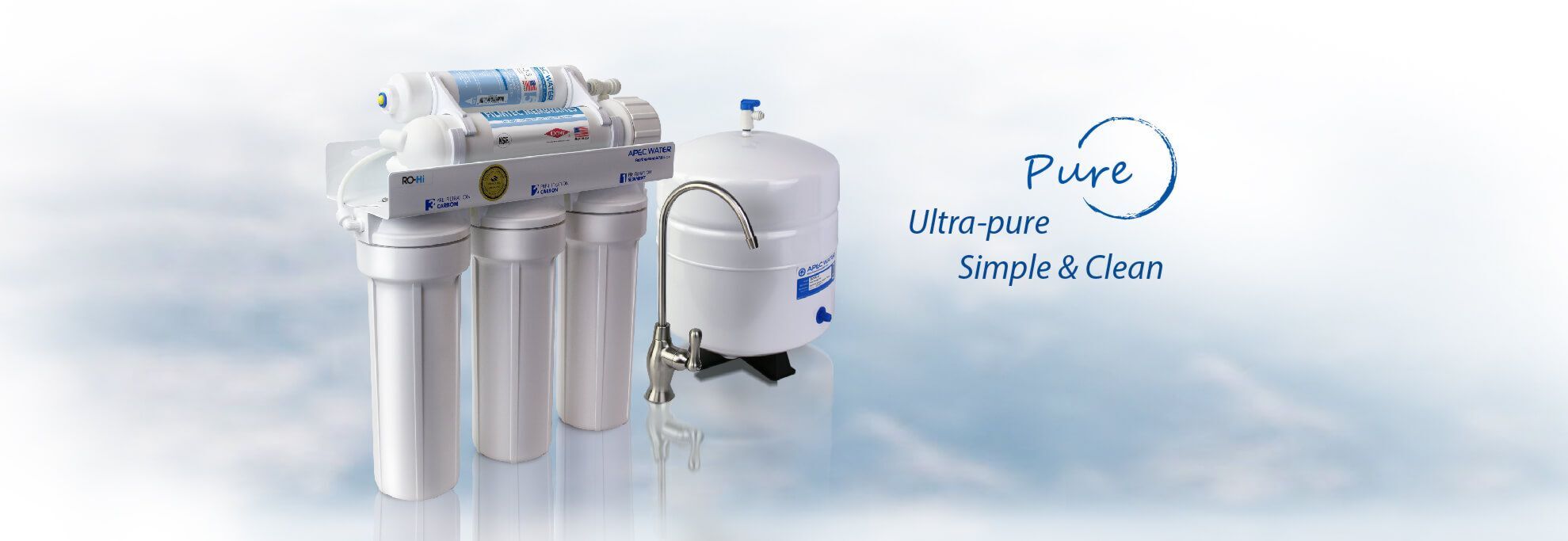
Home of APEC Ultra Reverse Osmosis Water Filter Systems
View your basket contentsCheckout from the store
 

Water Education  

Learning Center Categories:

Water And Health

Learn About Water Quality

Water Can Heal!

Contaminants Fact Sheets

Top Water News


Did you know?
Reverse osmosis is the finest water filtration method known. This process will allow the removal of particles as small as ions from a solution. It is used to purify water and remove salts and other impurities in order to improve the color, taste or properties of the fluid. R.O. uses a membrane that is semi-permeable, allowing the fluid that is being purified to pass through it, while rejecting other ions and contaminants from passing
. This technology uses a process known as crossflow to allow the r.o. membrane to continually clean itself. This is the reason of why an r.o. element can last many years before clogging or need replacement. This water purification process requires a driving force to push the fluid through the membrane, and the most common force is household water pressure or pressure from a booster pump. The higher the pressure, the larger the driving force and efficiency.


Water And Health

The importance of water and health
Are you getting enough?
Can beverages/drinks replace water?
Health risks of heavy metals
When and who should drink more water?
Water and pregnancy
Water and children
Water and the elderly
Nitrate and our health
Organic food and water!

The fluoride debate
Overall contamination of water, air and EMW
Water habits while growing up can fight obesity
Water intake with prescription drugs
Do we really need vitamins? water dosage
Water after vigorous exercise
Water and beautiful skin
Benefits of pure clean water for our pets

Water quality and plants
Top ten unhealthiest food and detoxing w/water
Water and tips to sober up
Water for people w/ weak immune systems
Pure water for infants/babies
Difference between organic/inorganic minerals

Drinking water can really save money!
More Topics...


The link between hard, soft water and cardiovascular disease.

There is currently a medical controversy over what effect, if any, drinking hard or soft water may have on heart disease. In some areas with naturally soft water, residents seem to suffer more from heart disease. In other areas, there appears to be no difference between drinking hard and soft water. A number of researchers feet that some other constituent of water -- not hardness or softness may be responsible for the variations in heart disease figures in different areas of the country.

Some researchers believe that very small amounts of a "protective" substance may be present in some water supplies and lacking in others. This unknown substance could have a beneficial effect on the heart in much the same way that minute amounts of fluoride protect the teeth. At the present time, no one knows exactly what this substance may be. Other scientists feel that the problem might be caused by other elements, such as cadmium, in the drinking water. It is known that this metal can cause high blood pressure when taken in small quantities. Trace amounts of cadmium can be dissolved from galvanized water pipes by the corrosive action of naturally soft water.

Over the years many studies have been published on the relationship between drinking water and cardiovascular mortality. Two beneficial factors continually stand out -hardness and total dissolved solids. Both have been associated with lower mortality from heart disease. Hardness refers to the amount of calcium and magnesium, or calcium carbonate in the water. The more calcium carbonate, the harder the water; the less, the softer the water. The first major study on drinking water and heart disease was in 1960 by Schroeder. In his paper, "Relation Between Mortality from Cardiovascular Disease and Treated water Supplies,' the water in 163 largest cities in the United States was analyzed for 21 constituents and correlated to heart disease.

He concluded "some factor either present in hard water, or missing or entering in soft water is associated with higher death rates from degenerative cardiovascular disease." In 1979 after reviewing fifty studies, Corn stock concluded, "there can be little doubt that the associations of water hardness with cardiovascular mortality are not spurious. Too many studies have reported statistically significant correlations to make chance or sampling errors a likely explanation." He suggests that the reason for this association is due to a "deficiency of an essential element or an excess of a toxic one." Certainly a combination of both is also possible.

Today after thirty years of research we are left with Schroeder's initial conclusion-drinking hard water results in less cardiovascular disease than drinking soft water. Yet over the years there have been several published reports analyzing specific elements in drinking water and their possible relationship to heart disease. One researcher studies zinc, another copper; another selenium, and so on. And as you read this material, you find an inconsistent and confusing picture. But, if you look at the broader picture, if you look at the studies on hardness, you will find very consistent results: namely, the harder the water the less heart disease deaths.

Before highlighting some of the major studies let's discuss TDS, total dissolved solids. TDS is a measurement of all the minerals in drinking water TDS not only includes calcium and magnesium (the hardness factors), but also zinc, copper chromium, selenium and so on. Sauer analyzed 23 drinking water characteristics in 92 cities ("Relationship of Water to the Risk of Dying") and found people who drank water higher in TDS had lower death rates from heart disease, cancer and chronic diseases than people who drank water with low amounts of TDS. Frequently, where the water is hard the water is also high in TDS.

Although most studies on heart disease have not looked at TDS but at hardness, this factor has been ever present and may be playing a very significant role. The more we try to isolate and study the effects of individual minerals the more we can lose sight of the unifying, comprehensive, beneficial factors present in water like hardness, TDS, and pH. Perhaps one of the main reasons there are inconsistencies in the water story is simply because we are obsessed to locate a specific isolated element that is responsible for the beneficial effects of healthy drinking water. Lets look at some of the major studies. In Great Britain, the British Regional Heat Study analyzed 253 towns from 1969 to 1973. They found 10% to 15% more cardiovascular deaths in soft water areas than in hard water areas. They suggest that the ideal amount of hardness is approximately 170 mg/L (or ppm-parts per million).

In the United States, Greathouse and Osborne studied 4200 adults, ages 25 to 74 in 35 different geographic areas. Their findings? Again, less heart disease mortality in hard water areas than in soft water areas. A report by the Oak Ridge National Laboratory found that the calcium and magnesium in hard water reduces the risks of heart attacks and strokes. This study compared the health records of 1,400 Wisconsin mate farmers who drank well water from their own farms. The farmers who drank soft water suffered from heart disease, whereas, the farmers who drank hard water were, for the most part, free of the problem. Sometimes, the best experiments are those nature has been silently conducting for years. Some of the most revealing water studies are seen comparing two neighboring towns in which one town alters its hard water to create softer water.

What have been the effects of this action? A higher rate of heart disease mortality. We see this in the English towns of Scunthrope and Grimsby. Both towns drank the same water with 44.4 mg/L of hardness and had identical heart disease mortality rates. Scunthrope soften its water to 100 mg/L of hardness and within a few years a striking increase in cardiovascular deaths occurred. Whereas in Grimsby the rate was virtually the same as it had been. This pattern has also been reported in the Italian towns of Crevalcore and Montegiorgio and the Abruzzo region of Italy.

The National Academy of Sciences concluded, "An optimum conditioning of drinking water could reduce the amount of cardiovascular disease mortality by as much as 15% in the U.S. When looking at the research there is a definite relationship between water hardness and heart disease mortality. We should try to drink water that has approximately 170 mg/L of hardness; the level found Ideal In Great Britain. Second, there is a definite relationship with TDS and heart disease mortality. Higher levels of TDS results in less heart disease. Proper levels of hardness and TDS are two of the beneficial properties in drinking water constituting a healthy drinking water.


Click to see details of Ultra Reverse Osmosis Water Filter System !
Healthy and Convenient! Our Featured Drinking Water Filter System

More Topics on Water & Health

Can water help me live longer?
Start a drinking water regimen

Drink tea or water
Drinking clear water
Filtered water is healthier?
The most important vitamin in water
The standard of safe pool water
Gatorade or water for the flu
What can a warm lemon do to my drinking water

Stop retaining water by drinking more
The facts of Child birthing in water
A worldwide study: Bad water means bad health
Flooding & its health effects on water souces
Public health hazards of public swimming pools
Recipes for great drinks

Hydrotherapy benefits & tips 
Why drink water? I'm not thirsty
The role of water in dieting
Super water...Hype or Health?
Can't drink eight classes of water a day?
Mosquitoes affect water quality
Will drinking water influence sodium levels?
Alkaline...what's your body's pH levels?
Get a healthier with water
The correlation between hard, soft water & cardiovascular disease
Explained body's drought management system
Fluoridation & bone cancer risks
Improve fatigue & memory with water
Traveling with safe drinking water

Soft drinks & alcohol steal water from the body
Digest properly by drinking water
Remove harmful toxins from digestive tract
Chronic cellular dyhydration
Water stop disease causing acidosis
Water is better than soft drink
Toxoplasma parasites in your water
The causes of taking antacids and drinking water contain bacteria

Does perchlorate cause cancer?
Drinking water contaminated with TCE or PCE

Health problems related to water quality
Regulation for mercury contamination in bottled water
Sorces of lead beside drinking water
Water disinfection from chlorine to chloramines
Hepatitis A from drinking non-disinfected water
The benefits of catalysts clustered form of water
Waterborne diseases cause human health problems
Lung and stomach cancers via radon in drinking water

Feel younger or more vigorous with structural altered drinking water
Health risks from corrosion byproducts through galvanized drinking water pipes
The correlation between chemicals & calories, fat, cholesterol
AIDS virus in drinking water
Health threat from release of arsenic in public water distribution systems
Can bacteria in municipal water supply cause ulcers

Drinking water scam-structured forms of water
The health issue via high concentration of lead

Reduce coronary heart disease from drinking water
Legionnaires disease within general population
How cyanobacteria affect somone who participates in renal dialysis
Poor quality drinking water can cause travelers' diarrhea
Drinking 2 liters of water daily can detoxify your body
Health benefits from drinking ionized water
The role of water in practice of homeopathy

Ingestion of nanoscopic particles


The best way for consumers to get cleaner and safer drinking water is to use reverse osmosis systems made by a recognized manufacturer-APEC water systems. According to Department of Health and Human service, reverse osmosis filters provide protection against viruses, bacteria, and protozoa due to its small filter pores. If you are among those whose water supply is safe, but not very palatable, these kinds of water filters can improve the taste of tap water by removing impurities. To kill viruses, rather than disinfect the water with iodine or chlorine, filtration kits such as UV light can also effectively remove viruses. Proper selection, operation, and maintenance of water filters are essential to producing safe water. Also please check out our super sale on the revolutionary Salt-Free water softeners/ conditioners.

= Products of Superior Performance and Dependability APEC Reverse Osmosis Made In USA
APEC reverse osmosis water filters/ softeners
Reverse Osmosis Products

Replacement Filters & Parts
Shower Filters and Bath Balls
Whole House Water Filters
Salt-Free Water Softeners
Classic Water Softeners

Electronic Water Softeners
Product category list
F.A.Q.s
Reverse Osmosis Technical Center
Learn the Truths About Our Drinking Water
Contaminant Fact Sheets
Water Can Cure Diseases
Water And Our Health
Top Water News

Contact APEC
Current Promotions
Our Reviews
About APEC
Refer & Get Cash
Warranty
APEC Reverse Osmosis Water Filters