
Home of APEC Ultra Reverse Osmosis Water Filter Systems
View your basket contentsCheckout from the store
 

Drinking Water Contaminants- Nitrates/Nitrites


Learning Center Categories:

Water And Health

Learn About Water Quality

Water Can Heal!

Contaminants Fact Sheets

Top Water News

~~~~~~~~~~~~~

Inorganic Contaminants

Arsenic
Antimony
Asbestos
Barium
Beryllium
Cadmium
Chromium
Copper
Cyanide

Fluoride
Lead
lead removal
Mercury
Nitrate/Nitrite
Selenium
Thallium

~~~~~~~~~~~~~

Microbes/
bacteria

E Coli Bacteria
Cryptosporidium

~~~~~~~~~~~~~

Radioactive
Radon

~~~~~~~~~~~~~

Others
MTBE

~~~~~~~~~~~~~

Volatile Organic Contaminants
(VOCS)

Benzene
Carbon Tetrachloride
Chlorobenzene 
o-Dichlorobenzene**
p-Dichlorobenzene 
1,1-Dichloroethylene
cis-1,2-Dichloroethylene
trans-1,2-Dicholoroethylene

Dichloromethane
1,2-Dichloroethane
1,2-Dichloropropane
Ethylbenzene
Styrene
Tetrachloroethylene
1,2,4-Trichlorobenzene
1,1,1,-Trichloroethane 
1,1,2-Trichloroethane
Trichloroethylene 
Toluene
Vinyl Chloride
Xylenes 


This is a factsheet about a chemical that may be found in some public or private drinking water supplies. It may cause health problems if found in amounts greater than the health standard set by the United States Environmental Protection Agency (EPA).

What are Nitrates/Nitrites and how are they used?

Nitrates and nitrites are nitrogen-oxygen chemical units which combines with various organic and inorganic compounds. Once taken into the body, nitrates are converted into nitrites. The greatest use of nitrates is as a fertilizer.

Why are Nitrates/Nitrites being regulated?

In 1974, Congress passed the Safe Drinking Water Act. This law requires EPA to determine safe levels of chemicals in drinking water which do or may cause health problems. These non-enforceable levels, based solely on possible health risks and exposure, are called Maximum Contaminant Level Goals.

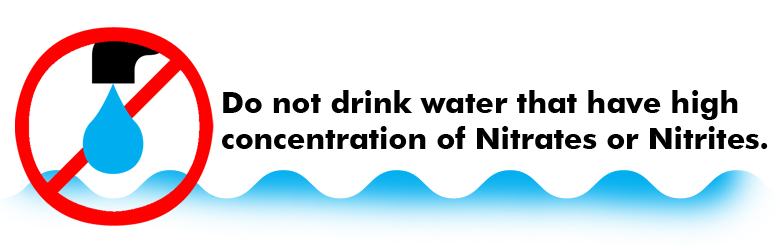
The MCLG for nitrates has been set at 10 parts per million (ppm), and for nitrites at 1 ppm, because EPA believes this level of protection would not cause any of the potential health problems described below.
Based on this MCLG, EPA has set an enforceable standard called a Maximum Contaminant Level (MCL). MCLs are set as close to the MCLGs as possible, considering the ability of public water systems to detect and remove contaminants using suitable treatment technologies.

The MCL for nitrates has been set at 10 ppm, and for nitrites at 1 ppm, because EPA believes, given present technology and resources, this is the lowest level to which water systems can reasonably be required to remove this contaminant should it occur in drinking water.

These drinking water standards and the regulations for ensuring these standards are met, are called National Primary Drinking Water Regulations. All public water supplies must abide by these regulations.

What are the health effects?

Short-term: Excessive levels of nitrate in drinking water have caused serious illness and sometimes death. The serious illness in infants is due to the conversion of nitrate to nitrite by the body, which can interfere with the oxygen-carrying capacity of the childs blood. This can be an acute condition in which health deteriorates rapidly over a period of days. Symptoms include shortness of breath and blueness of the skin.

Long-term: Nitrates and nitrites have the potential to cause the following effects from a lifetime exposure at levels above the MCL: diuresis, increased starchy deposits and hemorrhaging of the spleen.

How much Nitrates/Nitrites are produced and released to the environment?

Most nitrogenous materials in natural waters tend to be converted to nitrate, so all sources of combined nitrogen, particularly organic nitrogen and ammonia, should be considered as potential nitrate sources. Primary sources of organic nitrates include human sewage and livestock manure, especially from feedlots.

The primary inorganic nitrates which may contaminate drinking water are potassium nitrate and ammonium nitrate both of which are widely used as fertilizers.

According to the Toxics Release Inventory, releases to water and land totaled over 112 million pounds from 1991 through 1993. The largest releases of inorganic nitrates occurred in Georgia and California.

What happens to Nitrates/Nitrites when they are released to the environment?

Since they are very soluble and do not bind to soils, nitrates have a high potential to migrate to ground water. Because they do not evaporate, nitrates/nitrites are likely to remain in water until consumed by plants or other organisms.

How will Nitrates/Nitrites be detected in and removed from my drinking water?

The regulation for nitrates/nitrites became effective in 1992. Between 1993 and 1995, EPA required your water supplier to collect water samples at least once a year and analyze tem to find out if nitrates/nitrites are present above 50 percent of their MCLs. If it is present above this level, the system must continue to monitor this contaminant every 3 months.

If contaminant levels are found to be consistently above their MCLs, your water supplier must take steps to reduce the amount of nitrates/nitrites so that they are consistently below that level. The following treatment methods have been approved by EPA for removing nitrates/nitrites: Ion exchange, Reverse Osmosis, Electrodialysis.

How will I know if Nitrates/Nitrites are in my drinking water?

If the levels of nitrates/nitrites exceed their MCLs, the system must notify the public via newspapers, radio, TV and other means. Additional actions, such as providing alternative drinking water supplies, may be required to prevent serious risks to public health.

Drinking Water Standards (ppm): MCLG MCL

Nitrate: 10 10
Nitrite: 1 1

Nitrate and Nitrite Releases to Water and Land: 1991 to 1993 (in pounds)


  Water Land
TOTALS 59,014,378 53,134,805

Top Fifteen States*
GA 12,114,253 12,028,585
CA 0 21,840,999
AL 3,463,097 6,014,674
LA 8,778,237 2,250
MO 6,985,890 206,181
MS 6,952,387 0
KS 5,140,000 877,095
VA 5,091,764 0
NV 0 4,977,482
FL 1,056,560 1,835,736
AR 1,206,610 1,058,294
MD 1,802,219 138,819
IA 1,500,340 132,042
OK 1,436,348 14,199
UT 0 1,045,400

Major Industries*
Nitrogenous fertilizer 41,584,611 8,607,376
Misc. Ind. inorganics 4,113,312 29,676,919
Misc. Metal ores 0 5,764,976
Misc. Ind. organics 5,091,764 0
Fertilizer mixing 480,000 4,554,916
Explosives 850,921 1,297,590
Paper mills 1,727,061 0
Pulp mills 1,321,500 3,350
Canned foods 0 1,056,794
Phosphate fertilizers 1,000,000 0
As part of the Drinking Water and Health pages, this fact sheet is part of a larger U.S. EPA publication:
EPA National Primary Drinking Water Regulations

Click to see details of Ultra Reverse Osmosis Water Filter System !
Featured Product: Reverse Osmosis Drinking Water System (RO-45)


Tire of filling and refilling pitchers, wait for a long time to get few cups of clean water a day, or have a system that clog up or stop working after couple days of operation? You might be better off with an under sink reverse osmosis from APEC water systems. Our state-of-the-art, ultra pure water system delivers water of part-per-billion purity levels, so you can have the same water quality like those name brand bottled water. For people who have weak immune systems, cancer patients, or those whose water quality is particularly unstable should consider using reverse osmosis to purify their water. APEC has the most elaborate water purification systems without complicated installation. In addition, we offer lifetime technical support and consultations.

= Products of Superior Performance and Dependability APEC Reverse Osmosis Made In USA
Home of APEC Water Systems :: APEC Drinking Water Products Line :: APEC Reverse Osmosis Water Filters