
|
Learning
Center Categories:
Water
And Health
Learn
About Water Quality
Water
Can Heal!
Contaminants
Fact Sheets
Top
Water News
Did
you know?
Reverse osmosis is the finest water filtration method known. This process will
allow the removal of particles as small as ions from a solution. It is used
to purify water and remove salts and other impurities in order to improve the
color, taste or properties of the fluid. R.O. uses a membrane that is semi-permeable,
allowing the fluid that is being purified to pass through it, while rejecting
other ions and contaminants from passing.
This technology uses a process
known as crossflow to allow the r.o. membrane to continually clean itself. This
is the reason of why an r.o. element can last many years before clogging or
need replacement. This
water purification process requires a driving force to push the fluid through
the membrane, and the most common force is household water pressure or pressure
from a booster pump. The higher the pressure, the larger the driving force and
efficiency.
|
WHAT ARE THE STANDARDS FOR SAFE DRINKING WATER
It
is known that no one method of filtering or purifying water is going to
eliminate 100% of elements from our drinking water. That said, water
can be safe and acceptable, within reason. There are guidelines, set
by the U.S. EPA, which measure water standards to make sure our water
is safe.
'Acceptable'
contamination levels of water are measured by two standards: maximum contaminant
level (MCL) and maximum contaminant level goal (MCLG). For the list of
induvidual contaminant standards, please click
here.
The
goal indicates the level of contaminant at or below which is considered
safe for human consumption. However, given the size of most water systems,
today's technological limitations, and the costs involved with water purification,
it is impossible to provide the masses with water at or below goal level
for all contaminants.
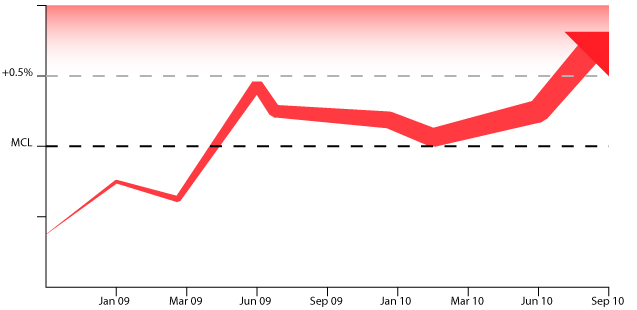
Because
of these difficulties, the MCL standard was created as a compromise between
public safety and feasibility, dictating levels that must be met before
water is distributed to the public. This level is usually within 5% of
acceptable contaminant range.
Post-Filtration
Contaminants
Turbidity
is a measure of the cloudiness of water, and an indication of filtration
effectiveness. Cloudy water is a sign of the presence of microorganisms
that can cause gastrointestinal illness. Although controlled at the original
filtration source, soil runoff and other factors can affect turbidity
levels by the time water reaches a faucet.
The
pipelines that transport water from its original purification source to
homes and businesses can affect certain contaminant levels. These include:
vinyl chloride, known to increase the risk of cancer (goal level is 0;
actual level is 0.02%); lead, which causes high blood pressure and kidney
disease in adults and developmental delays in children (goal level is
0; actual level is 0.015 mg/L); copper, which contributes to gastrointestinal
disease in the short-term and liver/kidney damage in the long-term (goal/actual
level of 1.3 mg/L); and cadmium, known to cause kidney damage (goal/actual
level of 0.005 mg/L).
Other
factors can further contaminate water between its original purification
and consumption. Fertilizer runoff and leaching from septic tanks can
cause increased levels of nitrite (goal/actual level of 1 mg/L) and nitrate
(goal/actual level of 10 mg/L), both of which are lethal to infants younger
than six months. Water storage tank liners leak small amounts of benzoapyrene
(goal level is 0; actual level is 0.0002 mg/L), which can cause reproductive
complications and increased cancer risk.
The
Effects of Disinfectants
Disinfectants
to remove contaminants can also be harmful to humans in and of themselves.
Use of disinfectants has led to the development of two additional water
safety standards: maximum residual disinfectant level (MRDL) and maximum
residual disinfectant level goal (MRDLG).
Just
as with contaminant level standards, it is not always realistic to reach
the residual disinfectant goal. In response, the MRDL offers a balance
between human safety and available purification resources.
Disinfectants
and their byproducts found in water include bromate, known to increase
the risk of developing cancer (goal level is 0; actual level is 1%) and
chlorite, which can cause nervous system damage in children as well as
anemia (goal level is 0.8 mg/L; actual level is 1.0 mg/L).
Although
there is a set standard for national water safety, individual standards
may vary by state, county, and facility.

Healthy and Convenient!
Our Featured Reverse Osmosis Drinking Water System
|