



Water and Gallstones
Some people who have had them removed like to keep them in jars. We're talking about gallstones. Perhaps people are marveled that something like that can form in the body, explaining why "amateur mad scientists" may like to keep body parts in jars after surgery. But as neat as they look rattling in that jar, gallstones are indeed painful. How do these stones form, and how can they be prevented? We'll address some of those issues now.
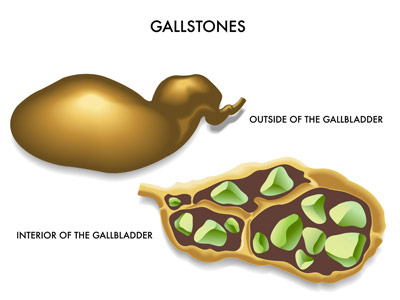
Thirty-million Americans suffer from gallstones, most of which are usually tiny, but sometimes golf ball size crystallized pellets form in the gallbladder. These stones cause painful spasms in the abdomen and can be accompanied by nausea, vomiting, heartburn, gas and bloating. Gallstones form due to mainly dietary reasons. Looking closer at a gallstone, we can find that it is actually made up of cholesterol deposits left over from the body's bile-making process. About three cups of bile is made in the liver each day, which is stored in the gallbladder, eventually released into the small intestine to aid in digestion, specifically the breaking up of fats. However, when there are high concentrations of cholesterol, the stones can form.
Gallstone may lead to other complications such as inflammation of the gallbladder, blockage of the bile or pancreatic duct, or even gallbladder cancer. But gallbladder cancer is rare even though the chance of the risk is elevated.
There are two types of gallstones:
- Cholesterol Stones – The most common type of gallstone. Mostly made of hardened cholesterol and are usually yellowish-green in color.
- Pigment Stones – Mostly made of bilirubin and are usually small and dark in color.
Cholesterol stones are the most common type of gallstone to develop, occurring in approximately 80% of patients with gallstones. Sometimes stones are tiny enough to pass, and some are too large and must be surgically removed. Sometimes, if they are large enough, they can also block the bile duct leading to the small intestine, which could cause serious infection. A gall bladder can have just one large stone, hundreds of tiny ones or a combination. The majority of individuals with gallstones do not have any symptoms. However, 20% of patients with gallstones report intense pain in the upper abdomen and in the back between the shoulder blades. Bloating and heartburn can also occur.
Also, cholesterol is not the only culprit- high sodium diets can also help create stones because if there is too much salt in the blood, the water supply goes down. Women are more likely to have stones. But, aside from the risk factors, some things can be done to prevent the stones- and water consumption is one way to make those stones roll away. There is no guaranteed way to prevent gallstones, but there are many things you can do to lower the risk.
