
Live chat by BoldChat
 

Education page - Side bar menu

Water Quality
  Water and Health   Water Quality   Water Can Heal   Contaminants Facts   Top Water News


Alkalinity of Drinking Water Explained

Alkalinity of water may be due to the presence of one or more of a number of ions. These include hydroxides, carbonates and bicarbonates. As discussed in previous articles, hydroxide ions are always present in water, even if the concentration is extremely low. However, significant concentrations of hydroxides are unusual in natural water supplies, but may be present after certain types of treatment. Small amounts of carbonates are found in natural water supplies in certain sections of the country, rarely exceeding 3 or 4 gpg. They may also be found in the water after lime soda has been used to soften the water. Bicarbonates are the most common sources of alkalinity. Almost all natural supplies have a measurable amount of this ion, ranging from 0 to about 50 gpg.
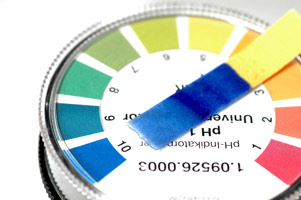
Alkalinity. The alkalinity of water may be defined as its capacity to neutralize acid. Alkali substances in water include hydroxides or bases. They can be detected by their acrid taste and by the fact that they cause red litmus paper to turn blue.

Alkaline Water

Phosphates and silicates are rarely found in natural supplies in concentrations significant in the home. Compounds containing these ions may be used in a variety of water treatment processes. Moderate concentrations of alkalinity are desirable in most water supplies to balance the corrosive effects of acidity. However, excessive quantities cause a number of problems. These ions are, of course, free in the water, but have their counterpart in cations such as calcium, magnesium and sodium or potassium.

You probably will not notice an alkaline condition due to bicarbonate ions except when present in large amounts. In contrast, you should readily detect alkalinity due even to fairly small amounts of carbonate and hydroxide ions.

Strong alkaline water has an objectionable "soda" taste. The EPA Secondary Drinking Water Regulations limit alkalinity only in terms of total dissolved solids (500 ppm) and to some extent by the limitation on pH.

Highly mineralized alkaline waters also cause excessive drying of the skin due to the fact that they tend to remove normal skin oils.

Troublesome amounts of alkalinity can be removed by reverse osmosis, along with other total dissolved solids. Other methods of water treatment also remove total dissolved solids, but they are somewhat less suitable for household use compared to reverse osmosis. These methods are distillation and deionization (demineralization).

Several other methods of water treatment will remove alkalinity, but these methods are not satisfactory for household use. They include:

Bottle Water Contaminants

1. Lime softening removes hardness. At the same time, this process will precipitate an equivalent amount of alkalinity. Lime softening is usually restricted to industrial and municipal installations.

Lime softening. While reducing total alkalinity, lime softening does convert HC03– to CO3--, a stronger alkalinity ion.

2. An anion resin regenerated with sodium chloride removes substantially all the anions (carbonates, bicarbonates, and sulfates, as well as nitrates). It replaces these anions with a chemically equivalent amount of chloride ions. The disadvantage of this process is that in almost all cases, it results in a high chloride ion concentration. At the point of exhaustion, the resin has the tendency to unload high concentrations of the anions it carries including the nitrates. For household purposes, such results are almost as undesirable as the original alkalinity.

3. The feed of a mineral acid will neutralize the alkalinity of a water. Hydrochloric acid, sulfuric acid or a combination of these can be used. This process converts the bicarbonates and carbonates present into carbonic acid. At this point, it is advisable to provide some method to permit the resulting carbon dioxide gas to escape into the atmosphere. The disadvantages of this acid feed technique are obvious. It is important to have precise control of the process and caution in handling the strong acid.

Read Next: What is Alkalinity?


Divider
 

Feature Products - Reverse Osmosis Water System

 
More Topics on Water Quality & Treatment:

General water treatment
Water quality defined
Hydrologic cycle of water
Meteoric water and cycle
Environmental factors of water
Age of ground water
Temperature of ground water
Water quality of surface water
Cistern water quality
Summary of water quality and the environment
pH value of water
Swimming/chlorine: protecting your skin and hair

Hard water problems
Softened water energy savings
Hard water analysis
Hard water and soap curd
Ion exchange principles
More on water softening
Home water softener basics
Water deionization
Lime soda ash water treatment
Popular filtration methods explained
Myth on minerals and water
Hard and soft water

3 Types of basic water
TDS-Total dissolved solids
Reverse osmosis treatment
Reverse osmosis and pH
Carbon dioxide in water
Chloride and sulfate
Fluoride in drinking water
Hydrogen sulfide in water
Nitrate/ nitrogen in water
Hard water explained
Alkalinity of water
Filtration OR Purification?

Disease-causing organisms
Micro-organism in water1
Micro-organism in water2
Viruses in drinking water
Bacteria in drinking water
Water disinfect methods1
Water disinfect methods2
Water disinfect-chlorine
Dechlorinating filters Q&A
Palatability of water
Coliform bacteria affect water quality

We are proud to be the authoritative website for information on water quality solutions, water purification and treatment. We provide heavy duty, professional water filtering products to remove contaminants caused by industrial and agricultural water pollution and contamination to provide safe and pure drinking water. Many of our top quality home reverse osmosis drinking water systems, whole house water filters, salt-free water softeners, and electronic water softeners/conditioners are currently on sale.
  = Products of Superior Performance and Dependability