
Home of APEC Ultra Reverse Osmosis Water Filter Systems
View your basket contentsCheckout from the store
 

Water Education  

Learning Center Categories:

Water And Health

Learn About Water Quality

Water Can Heal!

Contaminants Fact Sheets

Top Water News


Did you know?
Reverse osmosis is the finest water filtration method known. This process will allow the removal of particles as small as ions from a solution. It is used to purify water and remove salts and other impurities in order to improve the color, taste or properties of the fluid. R.O. uses a membrane that is semi-permeable, allowing the fluid that is being purified to pass through it, while rejecting other ions and contaminants from passing
. This technology uses a process known as crossflow to allow the r.o. membrane to continually clean itself. This is the reason of why an r.o. element can last many years before clogging or need replacement. This water purification process requires a driving force to push the fluid through the membrane, and the most common force is household water pressure or pressure from a booster pump. The higher the pressure, the larger the driving force and efficiency.


The "Truth" on our water
Contaminants and health effects
Water quality problems and solutions
Sources of our drinking water
Standards for drinking water
Hard and soft water
pH value of water

Filtration OR Purification?
Myth on minerals and water
Popular filtration methods explained
How to test your water pressure
How to set up your own well
Swimming/chlorine: protecting your skin and hair
How tap water is treated and delivered

The bottled water purification process
Safe to drink the water from a private well?
How Filters can prolong the life of water pipes
Drinking water quality and acid rain
More Topics...

What is spring water and how is it so safe?

A spring is a water resource formed when the side of a hill, a valley bottom or other excavation intersects a flowing body of ground water at or below the local water table, below which the subsurface material is saturated with water. A spring is the result of an aquifer being filled to the point that the water overflows onto the land surface. They range in size from intermittent seeps, which flow only after much rain, to huge pools flowing hundreds of millions of gallons daily.
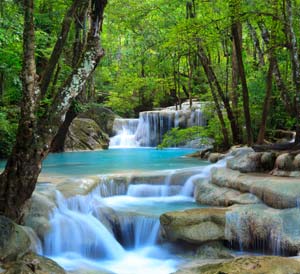
Springs are not limited to the Earth's surface, though. Recently, scientists have discovered hot springs at depths of up to 2.5 kilometers in the oceans, generally along mid-ocean rifts (spreading ridges). The hot water (over 300 degrees Celsius) coming from these springs is also rich in minerals and sulfur, which results in a unique ecosystem where unusual and exotic sea life seems to thrive.

Springs may be formed in any sort of rock. Small ones are found in many places. In Missouri, the largest springs are formed in limestone and dolomite in the karst topography of the Ozarks. Both dolomite and limestone fracture relatively easily. When weak carbonic acid (formed by rainwater percolating through organic matter in the soil) enters these fractures it dissolves bedrock. When it reaches a horizontal crack or a layer of non-dissolving rock such as sandstone or shale, it begins to cut sideways, forming an underground stream.

As the process continues, the water hollows out more rock, eventually admitting an airspace, at which point the spring stream can be considered a cave. This process is supposed to take tens to hundreds of thousands of years to complete. The amount of water that flows from springs depends on many factors, including the size of the caverns within the rocks, the water pressure in the aquifer, the size of the spring basin, and the amount of rainfall.

Human activities also can influence the volume of water that discharges from a spring-ground-water withdrawals in an area can reduce the pressure in an aquifer, causing water levels in the aquifer system to drop and ultimately decreasing the flow from the spring. Most people probably think of a spring as being like a pool of water-and normally that is the case. But, as this picture of the wall of the Grand Canyon in Arizona, USA shows, springs can occur when geologic, hydrologic, or human forces cut into the underground layers of soil and rock where water is in movement. Water from springs usually is remarkably clear. Water from some springs, however, may be "tea-colored." This picture shows a natural spring in southwestern Colorado. Its red iron coloring and metals enrichment are caused by ground water coming in contact with naturally occurring minerals present as a result of ancient volcanic activity in the area.

In Florida, many surface waters contain natural tannic acids from organic material in subsurface rocks, and the color from these streams can appear in springs. If surface water enters the aquifer near a spring, the water can move quickly through the aquifer and discharge at the spring vent. The discharge of highly colored water from springs can indicate that water is flowing quickly through large channels within the aquifer without being filtered through the soil. The quality of the water in the local ground-water system will generally determine the quality of spring water.

The quality of water discharged by springs can vary greatly because of factors such as the quality of the water that recharges the aquifer and the type of rocks with which the ground water is in contact. The rate of flow and the length of the flow path through the aquifer affects the amount of time the water is in contact with the rock, and thus, the amount of minerals that the water can dissolve. The quality of the water also can be affected by the mixing of freshwater with pockets of ancient seawater in the aquifer or with modern seawater along an ocean coast.

So, should you feel confident about whipping out your canteen and filling it with cool and refreshing spring water? No, you should be cautious. The temperature of an Ozark spring comes from its passing through rock at a mean annual temperature of 56 degrees Fahrenheit. The water is crudely filtered in the rock, and the time spent underground allows debris and mud to fall out of suspension. If underground long enough, lack of sunlight causes most algae and water plants to die. However, microbes, viruses, and bacteria do not die just from being underground, nor are any agricultural or industrial pollutants removed.

By the way, a spring is defined as a concentrated discharge of ground water to the surface. Ground water flows through aquifers (literally, water-bearers) from recharge areas, on uplands, where it is replenished by rainfall and snow melt to discharge areas, in valleys, where it flows to the surface into streams and rivers, providing them with dry-weather flow (see diagram above from Driscoll, 1987). When the flow paths are focused by either topographic or geologic factors, ground water will flow to the surface.

Most springs in can be generally classified as gravity springs. The water flowing from the recharge area has energy derived from the higher elevation of that area. This gravitational energy forces the water to move through the sand or rock of the aquifer. Most of the time, the energy is pretty much used up by the time the ground water discharges to a stream. Most springs are less spectacular than this. They often form where the slope of the land is steeper than the slope of the ground water surface (the water table), so that the ground water reaches the surface and flows out.

A spring develops best when the flow of this discharging water erodes the surface soil, forming a gully or rill, thus creating a low spot where more water can discharge. Such springs often form the headwaters of small streams, and are common around the edges of sand plains in southern Maine. The spring may continue to grow as the gully deepens and lengthens back into the slope, capturing more water. Water can also find its way to the surface through natural bedrock fractures, or through a sand layer sandwiched between clay layers.

These more permeable collectors, again, serve to focus the flow of ground water so that it flows from a small area instead of seeping from the entire hillside. The original Poland Spring was described in 1909: "The water issues from cracks in a dike of porphyry which is about 10 feet wide at the spring and strikes about N 80 degrees W, as nearly as can be estimated" (Clapp and Bayley, 1909). There were many developed springs in the late 1800's and early 1900's.

A 1906 U.S. Geological Survey census showed 44 commercial springs in southern Maine alone. Public water supplies were often from rivers and lakes (108 of 149), but many (29) communities used springs as their source of supply. Only a few springs still supply water to municipal supplies. Commercial springs often bottled water for the local market. Bottles of spring water were hauled by wagon from the spring, where they had been filled, to town, and delivered to customers.


Click to see details of Ultra Reverse Osmosis Water Filter System !
Healthy and Convenient! Our Featured Reverse Osmosis Drinking Water System

More Topics on Water Quality & Treatment:

General water treatment
Water quality defined
Hydrologic cycle of water
Meteoric water and cycle
Environmental factors of water
Age of ground water
Temperature of ground water
Water quality of surface water
Cistern water quality
Summary of water quality and the environment

Hard water explained
Hard water problems
Softened water energy savings
Hard water analysis
Hard water and soap curd
Ion exchange principles
More on water softening
Home water softener basics
Water deionization
Lime soda ash water treatment
Water softener alternatives
Truth about countertop & faucet water filters
3 Types of basic water
TDS-Total dissolved solids
Reverse osmosis treatment
Alkalinity of water
Reverse osmosis and pH
Carbon dioxide in water
Chloride and sulfate
Fluoride in drinking water
Hydrogen sulfide in water
Nitrate/ nitrogen in water
Oxygen in drinking water
Silica in drinking water
Sodium/methane/ phenol
Disease-causing organisms
Micro-organism in water1
Micro-organism in water2
Viruses in drinking water
Bacteria in drinking water
Water disinfect methods1
Water disinfect methods2
Water disinfect-chlorine
Dechlorinating filters Q&A
Palatability of water
Turbidity of drinking water
Mechanical filtration
Multi-media (depth filters)
Color of drinking water

Self maintenance guideline for private well owners
Water pressure matters
Common water usage of a household
Public water systems users
The guardian-Safe Drinking Water Act
The correct disinfection practice
Facts on home water treatment

Experiment1-water cycle purify our drinking water
Experiment2-pollution
Experiment3-waster filtration
Experiment4-build an aquifer
Experiment5-pollution control by using carbon
Experiment6-chlorination for disinfection
Experiment7-organisms in source water

Lead in your drinking water?
Arsenic in your drinking water
Read the bottled water label
Common bottled water treatment II
State certified lab for water testing
Earth water distribution
A natural setting for fish
Toxic algae treatment

Backcountry water drinking
Cl2 resistant pathogens
Common contaminants in the water system
Microbes & water quality
The origination of modern water filtration
Define Spring water & the safety
Water quality issues in Europe
Seawater drinkable?


How do water treatment plants work
How does Hydrology affect water
Barriers to quality water source management
Enough water for the future?
Water & agriculture..big connection
Climate change & the water
Negotiation of Water Rights
How pollution affect water?
How water prices were set?
How does Bay-scaping affect water
Nutrient management laws for water
Source Water Assessment Program
Water treatment techniques in the 1960's
Water treatment techniques in the 70's & 80's

How & Why Hazardous Events are monitored
America's ten most polluted rivers
Global Warming affects river & lakes
Define "Safe Water"
Potentially unsafe water in U.S. cities
Drink well water? Watershed management
Common microbes & the problems
To filter or purify water
The physical parameters of good water quality
The chemical parameters of good water quality
How does dissolved oxygen affect water quality
Micro me ida filtration: An alternative to membrane filtration
The "hidden" dangers of water

Biological oxygen demand affect water quality
Coliform bacteria affect water quality
What do Nitrate & Phosphate do?
Nitrogen level affects a long way
Stone Fly & May Flies show the water quality
Good water quality need adequate phosphorous level
What is a healthy watershed
The role of biological in watershed
Rainwater...future drinking water?
Eco-technology..the future of water treatment
Emerging issues of water & infectious diseases

Dirty water or bombs-Iraq
Terrorist attacks on water supplies
Hygiene & your water
Eutrophication in water
Explained Solar Water Disinfection
Perchlorate removal
The methods of selecting the best home water treatment
The health effects from Pesticides
How is water filtered in natural
Pharmaceuticals & Hormones in the water
Disease resistant DNA in the water
Anti-microbials & the danger to your water
The truth:How safe is American water


Introduction to water chemistry
Water chemistry-Atom & Molecules
Nuclear atom-Protons, Neutrons, & Electrons
Basic atom in Flourine, Magnesium, & Chlorine
The Isotopes of Hydrogen
Electrons in chemical interaction
Ionic reaction in natural
Remove Ionic impurities from water
Chemical term explained-Valence

Water problems- Iron
Introduce the state of Iron
Water problems- Manganese
Removal of Iron & Manganese from water
Ion exchange explained
An effective treatment for medium concentrations of Iron
Sequestration-Polyphosphate treatment explained
Chemical solution feeders explained
Water problems-Corrosion

Causes of corrosion
Corrosion on the common household used metals
Causes of corrosion explained II
The methods for controlling corrosion problem
Soft water to softened water
The needs for water testing
Correctly prepare water sample for testing
How to interpret water analysis I
How to interpret water analysis II
How to interpret water analysis III
How to interpret water analysis IV

How to choose the right plumber to install water softener
Recommended installation procedures-water softener
Installation equipments for the traditional water softener
Water softener installed in rural areas
Water softener installation-solution for pressure drop
Solution for pressure drop II- water softener


The five most common contamination sources for local drinking water
Monitoring finished water for good water quality
Water treatment -Magnesium deficiency
Arsenic exceed the drinking water standard
More regulations & research on drinking water
Explain Alkalinity
Impact on ground water quality
Potential drinking water source-Wastewater
Concern about GAC filtration systems that trap nitrate

Legality for a salt-based water softener
Methods of regenerate manganese greensand filter media

From chlorine to chlormaines
Humidifers operate better using filtered & purified water

Consumer confidence report to the public
Water contaminants -Cyanobacteria
Reverse osmosis can filter out Cryptosporidiosis microbes
Taste of water - TDS level
Private well water supplies - risk for Radon
Source for drinking water - Icebergs
Biofouling in a water pump/filter/plumbing system

Reasons for testing total coliforms & fecal coliforms
Drinking water reservoirs-manganese problems due to temperature stratification
Ozone treatment remove iron or manganese from water
Bacterial colonies-Biofilms

Public water treatment cost-Petroleum

Chloramines disinfection - Nitrite problem
Bottled water regulation - Mercury
The strangest compound known to man
The new detection of low levels of enteric viruses
The use of bio-sensors to detect Crypotosporidium-parvum bacteria
Produce higher quality well-water
Controlling taste & odor - Arizona
Methylmercury is a concern in aquatic environments

Time to backwash your acid neutralizing filter
Protecting pubic water systems from terrorist threats
Ultrafiltration(UF) & membrane filter technology
Restore oxidizing power of greensand water filters-potassium permanganate
Public health & bioterrorism act

Synthetic chemical vs. nature chemical-toxic level

Blue-green algae in surface water & distribution networks
The sources of Cryptosporidium other than water
Arsenic problem from disinfection of a ground water
Blue-green algae & cyanobacteria
The Effectiveness of Membrane filtration systems

The major elements of a consumer confidence report
Membrane technology
Viruses/bacteria/protozoan-the hardest to kill in drinking water
Genetic mutations of microbes
Private well water test-Nitrate
Disinfection of a ground water source for pathogen control & arsenic problem
Differentiate water filter system, descaler, conditioner, water softener

Phthalates as endocrine disruptors in the environment


Regulations-Gray water use
Regulations-Water pumped to the surface from oil & gas exploration
Lost the right to use water from a stream system
Water Rights-Separated from the the land to which it is attached
Take sand or gravel out of a stream
Construction codes for private well waters
Water Rights-Be aware of an offer from corporation to landowner
NPDES permit for associated storm water discharges at oil/gas extraction operations
Regulating dissolced oxygen concentrations in water

How many inches of water evaporated from the earth's hydrologic cycle
How much water returns to the earth's land surface as precipitation

Electric current-Seperate pure water into acidic/alkaline components
Improve water quality for certain uses with some contaminants
Differences in the natural quality of groundwater & surface water
Water supplies quality in urban & rural areas
How does natural purification of liquid water work on earth?
How do algae blooms cause severe oxygen depletion in water?
Is drinking water that meets drinking water standards suitable for kidney dialysis machines to remove wastes from a person?
What does water purity really mean?
What do we mean by an "unhealthy aquatic ecosystem?"

Can water absorb heat better than most substances?
Do water molecules have unique binding properties?
Salt concentration/salinity of water affect solubility of oxygen
Does water have unique thermal properties?
How much water evaporated from the earth's land surface per year?
Can water and oil be mixed to form a solution?
Can we produce electricity from tides and waves?

Can wetting agents improve the efficiency of irrigation water
How much water was used to produce the food item?
Do polyelectrolyte type chemical form weak or strong electrolytes in solution?
Does our neighboring planet of Mars have water?

Dose water dousing really work?
How big can hailstones get?
An indicator of chemical pollution with specific conductance of water
Can algae have beneficial effects on water supplies?
Do aquatic ecosystems have an unlimited capacity to maintain their quality?
How does saline ground water become saltier than ocean?
Fluoridated water in kidney dialysis machines
What are brine wells?
What are silicates & why are they in water?
What do we mean by an "unhealthy aquatic ecosystem?"

Can the oceans serve as a great power source for the earth?
Will salt dissolved in water increase or lower pH?
How do you calculate power needs for pumping water?
How does capillarity affect soil water holding capacity?
How does natural purification of liquid water work on earth?
How important are ocean phytoplankton organisms to total global photosynthesis?
How is energy generated in a hydroelectric power plant?

Sodium hexametaphosphate used as a dispersing & deflocculating agent
How is water a powerful source of energy?
The impact on reducing chemical dumping down household drains from grey-water usage
Can hydrogen peroxide improve the operation of a failing or faltering septic system?
Contaminate the environment with pharmaceuticals & personal care product from human activities

Reduce or eliminate non-point source pollutants in around my home
How do we determine water quality?
How do we measure water quality?
Access the STORET water quality data from EPA
How salty is sea water in comparison to fresh water?

Is sea water the saltiest water found on earth?
What are the key factors that influence water quality?
What does the definition of critical period mean for water purity standard?
What are the key factors that influence water quality?

The activity/action/practice that reduce natural water purification

Can overuse of water contribute to a failing OSDS system?
How far should personal drinking watre wells be sited from potential pollution sources?
Road or highway boundaries & property lines for private wells
The distance from septic tanks & fieldlines for private wells
Constructed a well-reduce the likelihood of contamination from a septic system

What is the cause of odor that resembles chloroform in my private well?
Should I worry about water pollution from antifreeze leaks onto my driveway?
Water pollution from solvents down the household drain
What can I do to prevent water pollution?
The recommended setback distance for a new private well from an operating or unplugged abandoned well
The recommended setback distance of septic tank systems from well
Radiator coolant water from automobiles that contain ethylene glycol antifreeze may kill animals
Drinking water standards vs. kidney dialysis standards

Is it common to find pure water in nature?
Is water pollution & water contamination the same thing?
What do we mean by water quality?
Silica/Silicates concentration in fresh surface/ground water supplies on earth

We are proud to be the authoritative website of Information on water quality solutions, water purification and treatment. We provide the most heavy duty, professional water filtering products to remove contaminants caused by industrial and agricultural water pollution and contamination to provide safe and pure drinking water. Many of our top quality home reverse osmosis drinking water systems, whole house water filters, salt-free water softeners, and electronic water softeners/conditioners are currently on sale.

= Products of Superior Performance and Dependability APEC Reverse Osmosis Made In USA
Home of APEC Water Filters
Reverse Osmosis Products

RO Replacement Filters & Parts
Whole House Water Filters/Conditoners
Saltless Water Softeners
Classic Water Softeners

Electronic Water Softeners/Conditioners
Product categories list
Frequently Asked Questions
Reverse Osmosis Technical Center
Learn the Truths About Our Drinking Water
Contaminant Fact Sheets
Water Can Cure Diseases
Water And Our Health
Top Water News

Contact APEC
Current Promotions
Our Reviews
About APEC
Refer & Get Cash
Warranty