


- The TRUTH About America's Water
- Water Pollutants that Cause Illness
- Are Minerals in Water Important for Health?
- Top 5 Drinking Water Contaminants
- Do I Need a Whole House Water Filter?

Corrosion on the common household used metals
We have limited our illustrations of corrosive activity to iron. This is not perhaps too strange, for we are all apt to think of corrosion primarily in relation to iron. In fact, most people consider iron the most widely used of all metals-as the metal that corrodes most easily.
Some metals are more chemically active than others. Some react more readily in forming ions or compounds. These reactions are linked to a metal's readiness to release electrons in the formation of compounds or ions. For example, some metals combine with oxygen or hydrogen quite easily; others are comparatively inert. Potassium, at one extreme, readily combines with oxygen. Gold, at the other extreme, is extremely stable.
A glance at the chart below shows that six metals are more chemically active than iron. In each case, they can be oxidized more easily. It may come as a surprise to note the positions of aluminum and zinc above iron on the list.
Some Common Metals in Order of Their Decreasing Activity from Anodic to Cathodic:
Anodic | 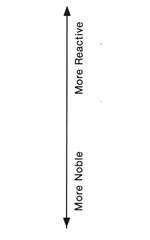 |
When aluminum or zinc are exposed to air oxidation occurs. However, the oxide that forms adheres to the metal underneath. In this way, the oxide acts as a protective coating to prevent, further contact between the bare metal and the air.
In contrast, when the iron is oxidized, the rust that forms may flake off almost as rapidly as it occurs. The reason for this: the oxidation of iron usually results in a rather porous material. In some cases, this deposit flakes off or washes away. In so doing, it continually exposes more metal. Even when iron oxide does not separate from the metal surface, it does not form a sufficiently solid coating to prevent continued corrosion. To control this corrosion of iron, coatings of other materials are usually applied to the surface.
Read Next:Next
