
| |||||||||||
| Water Education |
|
Learning Center Categories:
Did
you know? |
Water And Health
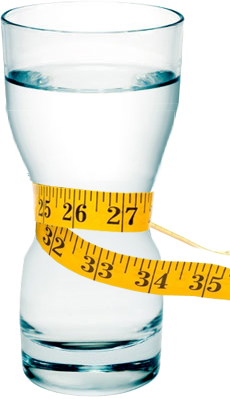
Stop retaining water…by drinking more! Women around the world constantly deal with the bloating, or retention of water in their bodies. It causes clothes to not fit that should and a general annoyance. So, is there anything natural a woman can do to help offset this hormonal by-product? It helps to start to understand what causes the body to retain water. Water helps your liver convert fat into usable energy. If you don't drink enough water, your kidneys are overwhelmed with concentrated fluids, and they make your liver do extra work. Your liver works hard to turn your body fat into energy you use, and if it has to do the kidney's work, then you hold onto the extra fat that would have been burned if you'd simply had enough water. And what's worse is that instead of excreting water and waste products, you reabsorb used water to reuse. This is what causes water retention and bloating. When you don't get enough water, your body panics and holds on to it selfishly, as though you're in a famine. The best way to get rid of this water retention is to drink enough of it. You'll also feel thirsty more often, and this will start a healthy cycle of thirst leading to hydration. But you have to keep it up because if you stop drinking enough water, all the good things you've gained from drinking water (balanced body fluids, weight loss, decreased hunger and thirst) will reverse back to the way they were. In the human body, water lubricates joints and organs. It maintains muscle tone. Water keeps skin soft. Water regulates body temperature, filters out impurities, and keeps the brain working properly. Water transports nutrients to and from cells. While the human body can store energy as glycogen, fat, and tissue, it cannot "store" water - the body uses its own water supply and expects a constant resupply of fresh water to function. Water is critical in moving nutrients into and out of a cell, an action known as the "ion pump". When you take in the improper balance of sodium and potassium or do not drink adequate water, your body will increase a hormone and try to "retain" water by keeping your kidneys from filtering it. Ironically, one of the best ways to stop retaining water is to drink more water! While humans can survive without food for several weeks (documented cases have shown lengths of up to two months), we can only survive a few days without water. Thirst is a signal that your body needs to be re-hydrated, but by the time you are thirsty it's already too late. Just a fraction of a percentage drop of your body's water supply can result into huge performance decreases. Even slight dehydration can be critical. In the recent sports season, a few deaths resulted from dehydration. Contrary to popular belief, "chugging" a gallon of water is not going to provide your body with the water it needs. When too much water floods your system at once, your body will pass most of it on to your bladder, and only absorb a slight amount. Weight in the stomach is a signal for digestive processes to begin, and a number of biological chemicals enter your stomach and change the pH balance. This can result in indigestion and stomach pain. The best way to take water is to steadily sip it throughout the day. You should also eat plenty of fruits and vegetables - most of the produce you eat is filled with water, and the body can process this water very efficiently. So - how much water? There are a million theories and equations. I've heard to drink "eight cups a day," which is better than nothing, but how can every adult, with so much variety of size, shape, metabolism, exercise habits, etc, require the exact same amount of water? Then there is the complicated equation that involves computing your basal metabolic rate and energy expenditure. I had to throw that one out, too - who wants to run a computer program every day just to figure out their water needs? I just prefer to drink like a fish and then I'm done with it. Just kidding. What I've found is two ways for computing water intake that both work incredibly well. The first is a little too vague for some people to follow, but very effective - it is recommended by nutritionist Will Brink. Will says to drink enough water to have two or three absolutely clear urinations per day. If you do not have these clear urinations, then either you are not drinking enough water, are not eating healthily or have some type of infection or other illness. For a normal, healthy adult, two or three clear urinations are a great "ruler." If you do not have these, then increase your water intake until it happens. If that is a little too general or explicit for you, another way is to take your weight and divide it in half. This is a "baseline" amount of ounces to drink every day. For every cup that you drink that is not water, drink a cup that is water. For every bout of exercise, drink a cup before and after, and one extra cup for every hour that you exercised (round up!). That's it. Let's take me as an example. If I weighed in at 200 pounds, 200 / 2 = 100 ounces of water, or about 12 cups. Let's say I also ran on the treadmill for 30 minutes. One cup before, one cup for the exercise, and one cup after is three cups total. 12 + 3 = 15 cups. I drank two cups of coffee, so I should have two extra cups of water. 15 + 2 = 17. That's it - today's water requirement for me is 17 cups! And I have no problem getting those in - I have an extra large mason jar that holds about 64 ounces. I fill these up and keep them full all day long. I sip them constantly. I probably end up drinking between one to two gallons today because I love my coffee and my exercise. The type of water to drink is the subject of much debate. I prefer filtered tap water because of the potential for harmful agents in "raw" tap water - although many health gurus recommend tap water due to the fact that they provide plenty of vitamins and minerals. Keep in mind that if you drink too much non-filtered water, you may increase your chances of acquiring kidney stones if there are many foreign materials that your body has to filter out. When you look at a water filter before you toss it out, that is exactly what your body's filter - the kidneys - would have had to process as well. Distilled water is also an option.
|
|||||||||||||||||||
The best way for consumers to get cleaner and safer drinking water is to use reverse osmosis systems made by a recognized manufacturer-APEC water systems. According to Department of Health and Human service, reverse osmosis filters provide protection against viruses, bacteria, and protozoa due to its small filter pores. If you are among those whose water supply is safe, but not very palatable, these kinds of water filters can improve the taste of tap water by removing impurities. To kill viruses, rather than disinfect the water with iodine or chlorine, filtration kits such as UV light can also effectively remove viruses. Proper selection, operation, and maintenance of water filters are essential to producing safe water. Also please check out our super sale on the revolutionary Salt-Free water softeners/ conditioners.
|
F.A.Q.s Reverse Osmosis Technical Center Learn the Truths About Our Drinking Water Contaminant Fact Sheets Water Can Cure Diseases Water And Our Health Top Water News |
Contact
APEC |
|