


Live chat by BoldChat
 

Education page - Side bar menus

Water Health
  Water and Health   Water Quality   Water Can Heal   Contaminants Facts   Top Water News


What if I can't drink eight glasses of water a day?

Bottled Water Contaminants

For years we've been admonished to chug eight glasses of water a day--for our skin, for our weight, for general good health. But--surprise--experts say that advice might not hold water. On the one hand, it seems that more people than ever are drinking heavily: College students bring bottles into classrooms; office workers nip from jugs all day long. Many of us are like Gerri Johnson, a 56-year-old kindergarten teacher living in Manhattan Beach, who says, "I carry a bottle of water throughout the day, and I'm always drinking. It flushes out my body, and it's good for my skin."
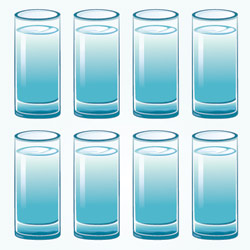
At the same time, some nutritionists insist that half the country is walking around dehydrated. We drink too much coffee, tea and sodas containing caffeine, which prompts the body to lose water, they say; and when we are dehydrated, we don't know enough to drink. Can it be so? Should healthy adults really be stalking the water cooler to protect themselves from creeping dehydration? Not at all, doctors say. "The notion that there is widespread dehydration has no basis in medical fact," says Dr. Robert Alpern, dean of the medical school at the University of Texas Southwestern Medical Center in Dallas.

Doctors from a wide range of specialties agree: By all evidence, we are a well-hydrated nation. Furthermore, they say, the current infatuation with water, as an all-purpose health potion--tonic for the skin, key to weight loss--is a blend of fashion and fiction and very little science. Consider that first commandment of good health: Drink at least eight 8-ounce glasses of water a day. This unquestioned rule is itself a question mark. Most nutritionists have no idea where it comes from. "I can't even tell you that," says Barbara Rolls, a nutrition researcher at Pennsylvania State University, "and I've written a book on water."

Some say the number was derived from fluid intake measurements taken decades ago among hospital patients on IVs; others say it's less a measure of what people need than a convenient reference point, especially for those who are prone to dehydration, such as many elderly people. Kidney specialists do agree on one thing, however: that the 8-by-8 rule is a gross overestimate of any required minimum. To replace daily losses of water, an average-sized adult with healthy kidneys sitting in a temperate climate needs no more than one liter of fluid, according to Jurgen Schnermann, a kidney physiologist at the National Institutes of Health. One liter is the equivalent of about four 8-ounce glasses.

According to most estimates, that's roughly the amount of water most Americans get in solid food. In short, though doctors don't recommend it, many of us could cover our bare-minimum daily water needs without drinking anything during the day. "Whenever I go to the airport I see all these people carrying around bottles of water, and I wonder, 'What's behind this?' " says Schnermann. "Certainly not science." Try confusion. The way it's almost always stated, in books, magazines and newspapers, the 8-by-8 rule specifically discounts caffeinated beverages, such as coffee.

This is flat wrong. Caffeine does cause a loss of water, but only a fraction of what you're adding by drinking the beverage. In people who don't regularly consume caffeine, for example, researchers say that a cup of java actually adds about two-thirds the amount of hydrating fluid that's in a cup of water. That is to say, one cup of coffee equals about two-thirds a cup of water--if you're not a regular caffeine drinker. Regular coffee and tea drinkers become accustomed to caffeine and lose little, if any, fluid. In a study published in the October issue of the Journal of the American College of Nutrition, researchers at the Center for Human Nutrition in Omaha measured how different combinations of water, coffee and caffeinated sodas affected the hydration status of 18 healthy adults who drink caffeinated beverages routinely.

"We found no significant differences at all," says nutritionist Ann Grandjean, the study's lead author. "The purpose of the study was to find out if caffeine is dehydrating in healthy people who are drinking normal amounts of it. It is not." The same goes for tea, juice, milk and caffeinated sodas: One glass provides about the same amount of hydrating fluid as a glass of water. The only common drinks that produce a net loss of fluids are those containing alcohol--and usually it takes more than one of those to cause noticeable dehydration, doctors say.

Do the Math: We're Drinking Plenty.

Top 5 Water Contaminants

Now, take a close look at a survey released this May by the International Bottled Water Assn. Based on interviews with 2,818 adults in 14 U.S. cities, the association concluded that "although an overwhelming majority of Americans know that drinking water enhances health, most don't drink as much per day as they should." Yet, according to the association's own numbers, Americans say they drink an average of 6.1 glasses of water, 3.7 servings of soda or sports drinks, 3.2 of coffee and tea, 1.9 of juice, 1.7 of milk, and one alcoholic drink each day.

All told, after subtracting the alcoholic drink, that's a sopping 15 glasses of hydrating fluids, well above the already exaggerated "minimum." And it doesn't even include the three or four glasses contained in solid food. What do we do with all this excess water? Ask any water junkie who's tried to sit through a movie lately: We run to the bathroom. For some people, drinking plenty of water is a very good idea. As we age, for example, many of us grow less sensitive to losses of body water and don't drink when we should. Developing a water habit is a good precaution against dehydration.

In addition, researchers have good evidence that people who develop kidney stones can lower their risk of further problems by drinking more fluids. "Those are the only patients we would tell to drink more water," says Alpern. But there are also people for whom guzzling water is dangerous. According to Dr. Gary Robertson, who studies water metabolism at Northwestern University Medical School in Chicago, these are patients whose bodies have trouble eliminating fluids--for example, those with diabetes who are taking anti-diuretic hormone, or ADH, which prevents the body from losing water. "The excess water cannot be excreted," he says, "and the result is water intoxication, which produces symptoms ranging from mild headache to confusion, coma, seizures and occasionally even death."


Feature Products - Reverse Osmosis Water System

More Topics on Water & Health:
Can water help me live longer?
Start a drinking water regimen
Drink tea or water
Drinking clear water
Filtered water is healthier?
The most important vitamin in water
The standard of safe pool water
Gatorade or water for the flu
What can a warm lemon do to my drinking water
Chlorine to chloramine conversion affects pet fish
Stop retaining water by drinking more
The facts of Child birthing in water
A worldwide study: Bad water means bad health
Flooding & its health effects on water souces
Public health hazards of public swimming pools
Recipes for great drinks
Hydrotherapy benefits & tips
Use water therapy to prevent peptic ulcers
Water softeners & your health
Radon health water myth
Water and pregnancy
Why drink water? I'm not thirsty
The role of water in dieting
Super water...Hype or Health?
Can't drink eight classes of water a day?
Mosquitoes affect water quality
Will drinking water influence sodium levels?
Alkaline...what's your body's pH levels?
Is colon hydrotherapy science or scam
Plastic bottles and your health
Pure water for infants/babies
Urine Color and Dehydration
Get a healthier with water
The correlation between hard, soft water & cardiovascular disease
Explained body's drought management system
Fluoridation & bone cancer risks
Improve fatigue & memory with water
Traveling with safe drinking water
Log reduction of water contamination
Biofilm control through antibiotics & biocides
Beware of BPA-containing polycarbonate plastic bottles
Hepatitis A drinking water risks
We are proud to be the authoritative website for information on water quality solutions, water purification and treatment. We provide heavy duty, professional water filtering products to remove contaminants caused by industrial and agricultural water pollution and contamination to provide safe and pure drinking water. Many of our top quality home reverse osmosis drinking water systems, whole house water filters, salt-free water softeners, and electronic water softeners/conditioners are currently on sale.
  = Products of Superior Performance and Dependability