
Perchlorate- Nation's lettuce crop contaminated with perchlorate
Lettuce safety Questioned
Concern is raised that much of the nation's winter crop may contain a rocket fuel chemical.
Lettuce contaminated by rocket fuel poses a potential human health threat, according to a report to be released today by an environmental watchdog group.
The Environmental Working Group, a pollution research and prevention organization, commissioned the first test for perchlorate in supermarket produce.
Little is known about perchlorate dangers in food, but many regulators agree that the issue deserves study.
The new report doesn't contain enough strong science to convince regulators of an immediate health risk, but it raises more questions about the effects of ongoing contamination from a Cold War rocket fuel factory along the Colorado River.
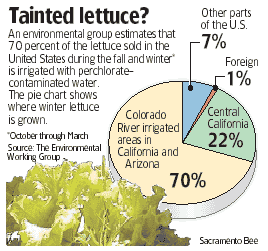
Irrigation spreads the tainted waters over 1.4 million acres of cropland in California and Arizona, including Imperial and Yuma counties, which grow 70 percent of the nation's winter lettuce.
Tests on 22 Northern California grocery store samples found perchlorate, a rocket fuel ingredient, in four lettuce samples -- though the chemical wasn't unequivocally linked to Colorado River-irrigated crops.
"The fact that this is now turning up in things that we eat really is an argument for doing as much as we can as fast as we can," said David Miller, spokesman for state Sen. Nell Soto, D-Ontario, who recently introduced legislation to track and clean up perchlorate contamination in California. "It clearly poses a growing threat not just to California, but to the rest of the country."
Texas Tech University, which analyzed samples purchased in January and February, found an average of 4 micrograms of perchlorate per 2-ounce serving in the contaminated samples. That would be about four times the amount deemed safe for a liter of drinking water, according to draft health standards by the U.S. Environmental Protection Agency.
State and national drinking water standards for perchlorate are being developed and will account for perchlorate exposure in humans from other sources such as food. In general, the more perchlorate found in the food chain, the lower the regulatory standard will be for drinking water.
In "Suspect Salads," the Environmental Working Group estimates that by eating lettuce, 1.6 million American women of childbearing age -- the population of greatest concern -- are exposed daily during the winter months to more perchlorate than the EPA's interim safe dose recommendation for water.
Perchlorate can hamper the thyroid gland's ability to take up the essential nutrient iodide and make thyroid hormones. It's especially dangerous for infants and children because thyroid hormone disruption can retard development, the group said.
"The real message is that any lettuce grown in any area with perchlorate-contaminated water has the potential to be contaminated with perchlorate," said Bill Walker, West Coast vice president for the Environmental Working Group in Oakland. "More research definitely needs to be done to discover what other food plants perchlorate may concentrate in and to what degree."
Walker acknowledged the limitations of his group's report, which did not identify where the studied lettuce was grown. He said chances are very good that it came from Imperial and Yuma counties because they account for an estimated 88 percent of lettuce sold in the United States during the time when the lettuce was purchased.
Scientific shortcomings also were noted by vegetable industry representatives and the EPA regional perchlorate coordinator, Kevin Mayer.
Given the lack of study protocol, "one really wouldn't expect to be able to come to conclusions that an agency like ours would be able to use," said Mayer, who works in the San Francisco office. "Having said that, it is useful to point (out) that a more thorough study, one that can provide some actual statistical rigor, certainly appears to be worth undertaking."
At Western Growers Association in Irvine, one of the nation's major vegetable industry groups, Executive Vice President Matt McInerney questioned the report's methodology and said government agencies should scientifically scrutinize perchlorate in the waters of more than 20 states.
"What I hope this drives the debate on is that it's a national issue that requires attention and appropriate science and appropriate measures to mitigate," he said. "Let's not let the issue get ahead of the science."
In California, lettuce and salad greens are the fifth-largest money crop, bringing $1.6 billion to farmers in 2001. Monterey County is the center of production, followed by Imperial and Fresno counties.
Jim Waddell, food and drug branch chief for the state Department of Health Services, said he still recommends a diet rich in fruits and vegetables.
"It would be incorrect to jump to any conclusions," he said. "We are working diligently ... to come out and say whether we have a safety issue or not."
At NewStar, a large vegetable grower and shipper with operations in the Salinas and Imperial valleys, Vice President Bob Whitaker said perchlorate contamination is such a new issue that there's no widely adopted industry testing standard.
"This is a very conscientious industry, and if there is an issue there, they will do everything possible to address it," he said.
He added: "It's not something the industry can address by itself. It's going to take a lot of people."
Perchlorate contamination started gaining increased public attention in 1997, when California health officials improved detection methods for perchlorate in water. That allowed extensive testing of contaminated areas.
A year later, Indian tribes with large lettuce operations in the Southwest pushed for federal studies after learning of perchlorate contamination in the Colorado River.
The source of the river's pollution is a closed perchlorate manufacturing plant near Las Vegas. More than 500 pounds of perchlorate flows from the site into Lake Mead and down the Colorado daily, according to the environmental group's report. Besides watering some of the nation's most valuable croplands, the Colorado River also supplies drinking water to Los Angeles and Phoenix.
Democratic California Sen. Barbara Boxer introduced federal perchlorate right-to-know legislation, similar to Soto's state bill, earlier this month. It's part of a growing national effort to get a handle on discharges of perchlorate from 1950 to the present. In the Rancho Cordova area, for instance, perchlorate contamination from rocket builder Aerojet has contaminated wells in the area.
"Up to 10 million Californians are currently drinking perchlorate-contaminated water, and we are continually discovering more contaminated drinking water sources," Boxer said in a statement. "Despite the gravity of this situation, we currently have no way of knowing who is dumping it or where they are dumping it, and there is no accountability. That is unacceptable."
In 1999, the Department of Defense aimed to analyze perchlorate in crops grown with Colorado River water. The EPA, the Agriculture Department and the Food and Drug Administration developed a study protocol that was shelved when the Defense Department said it didn't have $450,000 to pay for it.
Cornell Long, chief of the health risk assessment branch for the Air Force in San Antonio, said Defense Department agencies still don't have enough money to pay for a "market basket" study of several crops.
The Air Force, however, did fund a study of perchlorate in greenhouse-grown lettuce that was released in January. It showed perchlorate accumulation in young lettuce heads -- especially the outer leaves -- but said results in real fields and other crops would vary.
The FDA reportedly is investigating dangers of perchlorate in food. Attempts to reach the appropriate agency officials for comment were not successful.
At the USDA office of pest management policy, director Allen Jennings is working with a University of Arizona, Yuma, scientist to analyze a small sample of melons, carrots and grapes from Colorado River irrigated lands.
"It will be a snapshot of where we might have problems," he said. "There is enough concern out there that we really do need to know what residues are in the crops."
The key to the future of perchlorate regulation, however, remains EPA's drinking water standard, which is undergoing scientific review by the National Academy of Sciences. An EPA spokeswoman said the agency wouldn't comment on health risks until the science review is done. She did not know when it would be completed.
The state Department of Health Services is expected to set its own drinking water standard within a year, likely ahead of the federal government. It's also working with county agriculture commissioners to identify where perchlorate-contaminated groundwater may cause concern for irrigated crops.