



PALATABILITY OF DRINKING WATER
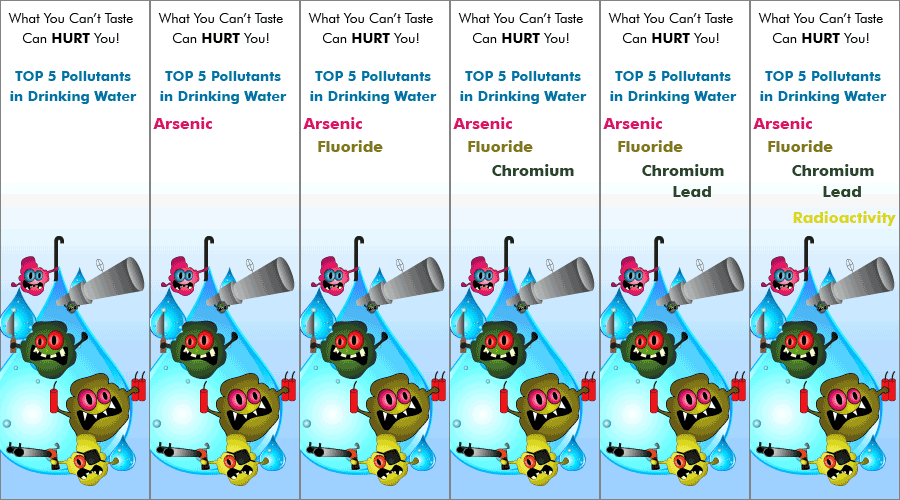
We have discussed at some length now various types of pathogens and methods of destroying them in the process of making water potable -- safe to drink. This is highly important, but it is not the whole story; for water must be palatable as well as potable.
What makes water palatable? To be palatable water should be free of detectable taste and odors.
What constitutes a detectable taste or odor? Undoubtedly, you have tasted waters that have had some unpleasant tastes or odors but were drinkable. And then there are those waters that have tastes and odors so obnoxious (hydrogen sulfide water, for example) that most people cannot even stomach them.
ODORS AND TASTES
Various odors and tastes may be present in water. They can be traced to many conditions. Unfortunately, the causes of bad taste and odor problems in water are so many, it is impossible to suggest a single treatment that would be universally effective in controlling these problems.
Tastes are generally classified into four groups -- sour, salt, sweet and bitter. Odors, on the other hand, possess many classifications. There are some 20 of the commonly used, all possessing rather picturesque names. In fact, the names in many cases, are far more pleasant than the odors themselves. To name a few of them -- nasturtium, cucumber, geranium, fishy, pigpen, earthy, grassy, and musty. Authorities further classify these odors in terms of their intensity from very faint, faint, distinct, and decided to very strong.
All taste buds and olfactory organs are not necessarily of the same acuteness, but generally, you should not be aware of any tastes or odors in water if there is to be pleasure in drinking it. If you are conscious of a distinct odor, the water is in need of treatment.
In many cases it is difficult to differentiate between tastes and odors. Both the taste buds and olfactory organs work so effectively together it is hard to determine where one leaves off and the other begins. To illustrate: hydrogen sulfide gives water an "awful" taste, yet actually it is the unpleasant odor of this gas that we detect rather than an unpleasant taste. Unfortunately, there is little in the way of standard measuring equipment for rating tastes and odors. Tastes and odors in water can be traced to a number of factors. They include:
- decaying organic matter;
- living organisms;
- iron, manganese and the metallic products of corrosion;
- industrial waste pollution from substances such as phenol;
- chlorination;
- high mineral concentrations;
- dissolved gases.
In general, odors can be traced to living organisms, organic matter, and gases in water. Likewise, tastes can be traced generally to the high total minerals in the water. There are, however, some tastes due to various algae and industrial wastes. Now how can these objectionable tastes and odors be removed from water?
Some tastes and odors, especially those due to organic substances, can be removed from water simply by passing it through an activated carbon filter. Other tastes and odors may respond to oxidizing agents such as chlorine and potassium permanganate. Where these problems are due to industrial wastes and certain other substances, some of the above types of treatment may completely fail. In some cases, for example, chlorination may actually intensify a taste or odor problem. Potassium permanganate has been found to be extremely effective in removing many musty, fishy, grassy, and moldy odors. Two factors make this compound valuable -- it is a strong oxidizing agent, and it does not form obnoxious compounds with organic matter. However, a filter must be used to remove the manganese dioxide formed when the permanganate is reduced.
In any case, you may have to try a number of methods in an attempt to rid water of objectionable tastes and odors. If methods considered here do not work, it may be more economical to seek out a new source of drinking water.