


|
Learning
Center Categories:
Water
And Health
Learn
About Water Quality
Water
Can Heal!
Contaminants
Fact Sheets
Top
Water News
Did
you know?
Reverse osmosis is the finest water filtration method known. This process will
allow the removal of particles as small as ions from a solution. It is used
to purify water and remove salts and other impurities in order to improve the
color, taste or properties of the fluid. R.O. uses a membrane that is semi-permeable,
allowing the fluid that is being purified to pass through it, while rejecting
other ions and contaminants from passing.
This technology uses a process
known as crossflow to allow the r.o. membrane to continually clean itself. This
is the reason of why an r.o. element can last many years before clogging or
need replacement. This
water purification process requires a driving force to push the fluid through
the membrane, and the most common force is household water pressure or pressure
from a booster pump. The higher the pressure, the larger the driving force and
efficiency.
|
TOTAL DISSOLVED SOLIDS IN WATER
Ionic Contaminants and Other Contaminants in Solution
and Suspended Contaminants
As
we learned previously, many dissolved inorganic water contaminants or
impurities exist as ions in solution, the most common of these ions are:
|
Cations
|
|
Anions
|
|
|
Calcium
|
Ca+ +
|
Bicarbonate
|
HC09
|
|
Magnesium
|
Mg++
|
Chloride
|
Cl
|
|
Sodium
|
Na+
|
Sulfate
|
SO,-
|
|
Iron
|
Fe+ +
|
Nitrate
|
NO,
|
|
Manganese
|
Mn+ +
|
Carbonate
|
CO,_ _
|
| |
|
|
|
These
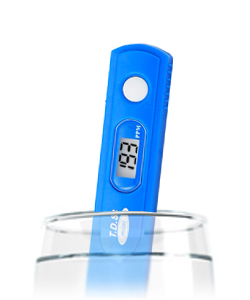
electrically charged dissolved particles make ordinary natural water a
good conductor of electricity. Coversely, pure water has a high electrical
resistance, and resistance is frequently used as a measure of its purity.
Since
only a few of these most common ionic water contaminants are health related,
most natural water supplies are safe to drink from the standpoint of dissolved
inorganic chemical contaminants. However, even though found more rarely
-- and in much smaller quantities -- certain inorganic ions can be toxic.
These contaminants are listed, along with their maximum allowable levels
in the summary, which also includes maximum levels for radiological ionic
contaminants, maximum levels for water turbidity (cloudiness), and maximum
levels for coliform bacteria (which indicate the presence of human or
animal fecal contamination). Turbidity and bacteria are examples of suspended
water contaminants.
In
addition, water supplies can contain dissolved organic chemical contaminants
which are usually pollutants that enter water as a result of man's activities,
such as insecticides, pesticides and herbicides. These are usually chronically,
rather than acutely, toxic to man and other species in extremely small
amounts. The trihalomethanes are dissolved organic contaminants, such
as chloroform, which are formed in extremely small amounts by the reaction
of chlorine used to disinfect water, with humic and fulvic acids from
soil erosion. Other organics can enter both surface and groundwater through
waste dumping, such as trichlorethylene, tetrachlorethylene (TCEs), polychlorinated
biphenyls (PCBs), dioxin, etc. Many of the organic contaminants are probably
carcinogenic (cancer-producing). The organics do not necessarily exist
in water in the form of dissolved ions.
The
Secondary Drinking Water Regulations control contaminants in drinking
water that primarily affect the aesthetic qualities of water. Several
of these -- chloride, sulfate, copper, iron, manganese, zinc, and total
dissolved solids -- are ionized contaminants.
Color
and odor are contaminants which cause objectionable sensory responses
to the water.
pH
is a measure of the acid or alkaline strength of a water supply and corrosivity
refers to the ability of a water supply to disintegrate pipes and containers.

Healthy and Convenient!
Our Featured Reverse Osmosis Drinking Water System
|