




The Ion Exchange Principle
The idea of ion exchange is not new. Scientists have been aware of the principle for a long time. However, it has only been since the start of the present century that the principle has been put to practical use. One area in which it has been highly effective has been in the treatment of water for the removal of hardness minerals and certain other contaminants. Ion exchange is the process through which ions in a solution are transformed into a solid which releases ions of a different type but of the same polarity. This means that the ions in solutions are replaced by different ions originally present in the solid. The physical separation process in which the ions are exchanged is not chemically altered.
Water that contains calcium and magnesium ions is also known as “hard water”. Hard water not only has an unappealing taste and odor, but it can also be unhealthy for you to drink. Hard water can cause scale build-up inside your water appliances and decrease the life expectancy of these appliances. One of the most commonly known ways to treat hard water is to use an ion-exchange water conditioner.
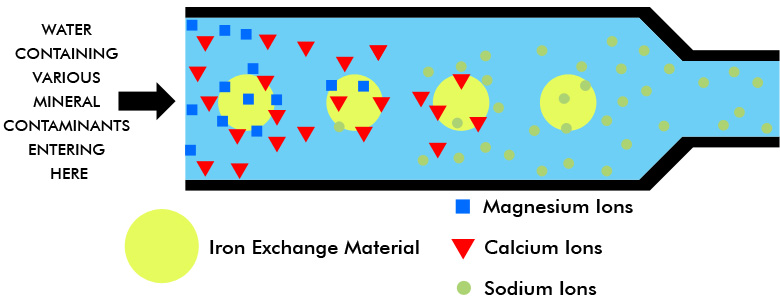
THE ION EXCHANGE COLUMN
HARD WATER ENTERING SOFTENER
All recognized household water softening equipment now on the market makes use of the ion exchange principle. Equipment using this principle contains a bed of permanent bead-like or granular softening material through which the water flows. As the water travels through the bed of ion exchange material, the hardness minerals are removed, leaving the water soft and more satisfactory for household use. The granules or particles of ion-exchange material in a softener are referred to as the bed.
