

Home of APEC Ultra Reverse Osmosis Water Filter Systems
View your basket contentsCheckout from the store
 

Water Education  

Learning Center Categories:

Water And Health

Learn About Water Quality

Water Can Heal!

Contaminants Fact Sheets

Top Water News


Did you know?
Reverse osmosis is the finest water filtration method known. This process will allow the removal of particles as small as ions from a solution. It is used to purify water and remove salts and other impurities in order to improve the color, taste or properties of the fluid. R.O. uses a membrane that is semi-permeable, allowing the fluid that is being purified to pass through it, while rejecting other ions and contaminants from passing
. This technology uses a process known as crossflow to allow the r.o. membrane to continually clean itself. This is the reason of why an r.o. element can last many years before clogging or need replacement. This water purification process requires a driving force to push the fluid through the membrane, and the most common force is household water pressure or pressure from a booster pump. The higher the pressure, the larger the driving force and efficiency.


The "Truth" on our water
Contaminants and health effects
Water quality problems and solutions
Sources of our drinking water
Standards for drinking water
Hard and soft water
pH value of water

Filtration OR Purification?
Myth on minerals and water
Popular filtration methods explained
How to test your water pressure
How to set up your own well
Swimming/chlorine: protecting your skin and hair
How tap water is treated and delivered

The bottled water purification process
Safe to drink the water from a private well?
How Filters can prolong the life of water pipes
Drinking water quality and acid rain
More Topics...


DIFFERENT WATER FILTRATION METHODS EXPLAINED


Water Purification Technologies


Distillation

Distillation is probably the oldest method of water purification. Water is first heated to boiling. The water vapor rises to a condenser where cooling water lowers the temperature so the vapor is condensed, collected and stored. Most contaminants remain behind in the liquid phase vessel. However, there can sometimes be what is called carry-overs in the water that is distilled. Organics such as herbicides and pesticides, with boiling points lower than 100 °C cannot be removed efficiently and can actually become concentrated in the product water. Another disadvantage is cost. Distillation requires large amounts of energy and water.

Distilled water can also be very acidic, having a low pH, thus should be contained in glass. Since there is not much left, distilled water is often called "hungry" water. It lacks oxygen and minerals and has a flat taste, which is why it is mostly used in industrial processes.

Table 1. Distillation
Advantages

Removes a broad range of contaminants

Reusable

Disadvantages

Some contaminants can be carried into the condensate

Requires careful maintenance to ensure purity

Consumes large amounts of energy

System usually takes a large space on counter


Ion Exchange

The ion exchange process percolates water through bead-like spherical resin materials (ion-exchange resins). Ions in the water are exchanged for other ions fixed to the beads. The two most common ion-exchange methods are softening and deionization.

Softening is used primarily as a pretreatment method to reduce water hardness prior to reverse osmosis (RO) processing. The softeners contain beads that exchange two sodium ions for every calcium or magnesium ion removed from the "softened" water.
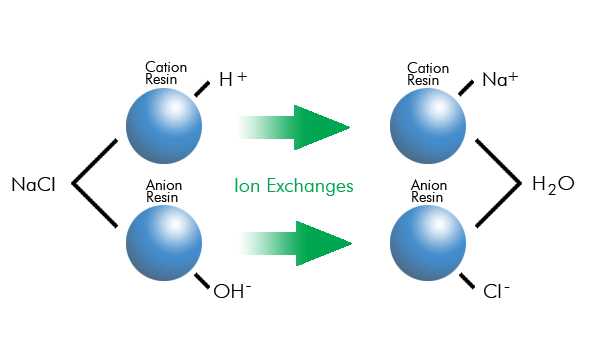
Deionization (DI) beads exchange either hydrogen ions for cations or hydroxyl ions for anions. The cation exchange resins, made of styrene and divinylbenzene containing sulfonic acid groups, will exchange a hydrogen ion for any cations they encounter (e.g., Na+, Ca++, Al+++). Similarly, the anion exchange resins, made of styrene and containing quaternary ammonium groups, will exchange a hydroxyl ion for any anions (e.g., Cl-). The hydrogen ion from the cation exchanger unites with the hydroxyl ion of the anion exchanger to form pure water.

These resins may be packaged in separate bed exchangers with separate units for the cation and anion exchange beds. Or, they may be packed in mixed bed exchangers containing a mixture of both types of resins. In either case, the resin must be "regenerated" once it has exchanged all its hydrogen and/or hydroxyl ions for charged contaminants in the water. This regeneration reverses the purification process, replacing the contaminants bound to the DI resins with hydrogen and hydroxyl ions.

Deionization can be an important component of a total water purification system when used in combination with other methods discussed in this primer such as RO, filtration and carbon adsorption. DI systems effectively remove ions, but they do not effectively remove most organics or microorganisms. Microorganisms can attach to the resins, providing a culture media for rapid bacterial growth and subsequent pyrogen generation. The advantages and disadvantages of this technology are summarized below.
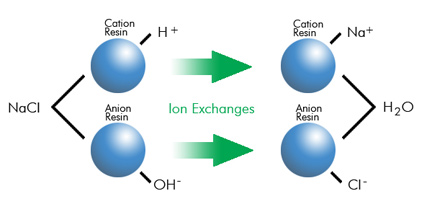
Table 3. Deionization
Advantages

Removes dissolved inorganics effectively.

Regenerable (service deionization).

Relatively inexpensive initial capital investment.

Disadvantages

Does not effectively remove particles, pyrogens or bacteria.

DI beds can generate resin particles and culture bacteria.

High operating costs over long-term.


Carbon Adsorption

Carbon absorption is a widely used method of home water treatment because of its ability to improve water by removing disagreeable tastes and odors, including objectionable chlorine. Activated carbon effectively removes many chemicals and gases, and in some cases it can be effective against microorganisms. However, generally it will not affect total dissolved solids, hardness, or heavy metals. Only a few carbon filter systems have been certified for the removal of lead, asbestos, cysts, and coliform. There are two types of carbon filter systems, each with advantages and disadvantages: granular activated carbon, and solid block carbon. These two methods can also work along with a reverse osmosis system, which can be read about below.

Activated carbon is created from a variety of carbon-based materials in a high-temperature process that creates a matrix of millions of microscopic pores and crevices. One pound of activated carbon provides anywhere from 60 to 150 acres of surface area. The pores trap microscopic particles and large organic molecules, while the activated surface areas cling to, or adsorb, small organic molecules.

The ability of an activated carbon filter to remove certain microorganisms and certain organic chemicals, especially pesticides, THMs (the chlorine by-product), trichloroethylene (TCE), and PCBs, depends upon several factors, such as the type of carbon and the amount used, the design of the filter and the rate of water flow, how long the filter has been in use, and the types of impurities the filter has previously removed.

The carbon adsorption process is controlled by the diameter of the pores in the carbon filter and by the diffusion rate of organic molecules through the pores. The rate of adsorption is a function of the molecular weight and the molecular size of the organics. Certain granular carbons effectively remove chloramines. Carbon also removes free chlorine and protects other purification media in the system that may be sensitive to an oxidant such as chlorine.

Carbon is usually used in combination with other treatment processes. The placement of carbon in relation to other components is an important consideration in the design of a water purification system.

Table 3. Carbon Adsorption
Advantages

Removes dissolved organics and chlorine effectively.

Long life (high capacity).

Disadvantages

Can generate carbon fines.


Microporous Basic Filtration

There are three types of microporous filtration: depth, screen and surface. Depth filters are matted fibers or materials compressed to form a matrix that retains particles by random adsorption or entrapment. Screen filters are inherently uniform structures which, like a sieve, retain all particles larger than the precisely controlled pore size on their surface. Surface filters are made from multiple layers of media. When fluid passes through the filter, particles larger than the spaces within the filter matrix are retained, accumulating primarily on the surface of the filter.

The distinction between filters is important because the three serve very different functions. Depth filters are usually used as prefilters because they are an economical way to remove 98% of suspended solids and protect elements downstream from fouling or clogging.

Surface filters remove 99.99% of suspended solids and may be used as either prefilters or clarifying filters. Microporous membrane (screen) filters are placed at the last possible point in a system to remove the last remaining traces of resin fragments, carbon fines, colloidal particles and microorganisms.

Table 4. Microporous Membrane Filtration
Advantages

Absolute filters remove all particles and microorganisms greater than the pore size.

Requires minimal maintenance.

Disadvantages

Will not remove dissolved inorganics, chemicals, pyrogens or all colloidals.

Potentially high expendable costs.

Not regenerable.


Ultrafiltration

A microporous membrane filter removes particles according to pore size. By contrast, an ultrafiltration (UF) membrane functions as a molecular sieve. It separates dissolved molecules on the basis of size by passing a solution through an infinitesimally fine filter.

The ultrafilter is a tough, thin, selectively permeable membrane that retains most macromolecules above a certain size including colloids, microorganisms and pyrogens. Smaller molecules, such as solvents and ionized contaminants, are allowed to pass into the filtrate. Thus, UF provides a retained fraction (retentate) that is rich in large molecules and a filtrate that contains few, if any, of these molecules.

Ultrafilters are available in several selective ranges. In all cases, the membranes will retain most, but not necessarily all, molecules above their rated size.

Table 5. Ultrafiltration
Advantages

Effectively removes most particles, pyrogens, microorganisms, and colloids above their rated size.

Produces highest quality water for least amount of energy.

Regenerable.

Disadvantages

Will not remove dissolved inorganics.


Reverse Osmosis

Reverse osmosis (RO) is the most economical method of removing 90% to 99% of all contaminants. The pore structure of RO membranes is much tighter than UF membranes. RO membranes are capable of rejecting practically all particles, bacteria and organics >300 daltons molecular weight (including pyrogens). In fact, reverse osmosis technology is used by most leading water bottling plants.

Natural osmosis occurs when solutions with two different concentrations are separated by a semi-permeable membrane. Osmotic pressure drives water through the membrane; the water dilutes the more concentrated solution; and the end result is an equilibrium.

In water purification systems, hydraulic pressure is applied to the concentrated solution to counteract the osmotic pressure. Pure water is driven from the concentrated solution and collected downstream of the membrane.

Because RO membranes are very restrictive, they yield slow flow rates. Storage tanks are required to produce an adequate volume in a reasonable amount of time.

RO also involves an ionic exclusion process. Only solvent is allowed to pass through the semi-permeable RO membrane, while virtually all ions and dissolved molecules are retained (including salts and sugars). The semi-permeable membrane rejects salts (ions) by a charge phenomena action: the greater the charge, the greater the rejection. Therefore, the membrane rejects nearly all (>99%) strongly ionized polyvalent ions but only 95% of the weakly ionized monovalent ions like sodium.

Reverse osmosis is highly effective in removing several impurities from water such as total dissolved solids (TDS), turbidity, asbestos, lead and other toxic heavy metals, radium, and many dissolved organics. The process will also remove chlorinated pesticides and most heavier-weight VOCs. Reverse osmosis and activated carbon filtration are complementary processes. Combining them results in the most effective treatment against the broadest range of water impurities and contaminants.

RO is the most economical and efficient method for purifying tap water if the system is properly designed for the feed water conditions and the intended use of the product water. RO is also the optimum pretreatment for reagent-grade water polishing systems.

In addition, Reverse osmosis treatment is an insurance policy against nuclear radiation such as radioactive plutonium or strontium in the drinking water. If one lives near a nuclear power plant, this is a key way to ensure the household is drinking the best water for their health.


Table 6. Reverse Osmosis
Advantages

Effectively removes all types of contaminants to some extent (particles, pyrogens, microorganisms, colloids and dissolved inorganics).

Requires minimal maintenance.

Disadvantages

Flow rates are usually limited to a certain gallons/day rating.


Ultraviolet (UV) Radiation

Ultraviolet radiation has widely been used as a germicidal treatment for water. Mercury low pressure lamps generating 254 nm UV light are an effective means of sanitizing water. The adsorption of UV light by the DNA and proteins in the microbial cell results in the inactivation of the microorganism.

Recent advances in UV lamp technology have resulted in the production of special lamps which generate both 185 nm and 254 nm UV light. This combination of wavelengths is necessary for the photooxidation of organic compounds. With these special lamps, Total Organic Carbon (TOC) levels in high purity water can be reduced to 5 ppb.

Table 8. Ultraviolet Radiation
Advantages

Effective sanitizing treatment.

Oxidation of organic compounds (185 nm and 254 nm) to < 5 ppb TOC

Disadvantages

Decreases resistivity.

Will not remove particles, colloids, or ions


Pulling It All Together


Water Purification Systems

Because each purification technology removes a specific type of contaminant, none can be relied upon to remove all contaminants to the levels required for critical applications. A well-designed water purification system uses a combination of purification technologies to achieve final water quality.

Each of the purification technologies must be used in an appropriate sequence to optimize their particular removal capabilities. The schematic below shows a central laboratory water purification system designed to produce water for critical applications.

The first step is pretreatment equipment specifically designed to remove contaminants in the feed water. Pretreatment removes contaminants that may affect purification equipment located downstream, especially reverse osmosis (RO) systems. Examples of pretreatment are: carbon filters (or tanks) for chlorine removal, particulate filters for sediment/silt/particulate removal, and softening agents to remove minerals that cause "hard" water.

The next purification step is RO. RO removes 90 to 99% of all the contaminants found in water. It is the heart of any well designed water purification system because it effectively removes a broad range of contaminants.

However, the tight porosity of the RO membrane limits its flow rate. Therefore, a storage container is used to collect water from the system and distribute it to other points-of-use such as polishing systems.

Polishing systems purify pretreated water, such as RO water, by removing trace levels of any residual contaminants. Polishing elevates the quality of pretreated water to "Type I" or "ultrapure" water.

A polishing system is designed to remove residual traces of impurities from water already pretreated by some other means (such as reverse osmosis or deionization). Treating raw tap water using such a system would quickly exhaust its capacity and affect final quality.

A typical polishing system may consist of activated carbon, mixed-bed deionization, organic scavenging mixtures and 0.22 µm final filtration. Systems can also be enhanced with ultrafiltration, ultraviolet oxidation or other features for use in specific applications.

This combination of purification technologies, combined with proper pretreatment, will produce water that is virtually free of ionic, organic and microbial contamination.

Click to see details of Ultra Reverse Osmosis Water Filter System !
Healthy and Convenient! Our Featured Reverse Osmosis Drinking Water System

More Topics on Water Quality & Treatment:

General water treatment
Water quality defined
Hydrologic cycle of water
Meteoric water and cycle
Environmental factors of water
Age of ground water
Temperature of ground water
Water quality of surface water
Cistern water quality
Summary of water quality and the environment

Hard water explained
Hard water problems
Softened water energy savings
Hard water analysis
Hard water and soap curd
Ion exchange principles
More on water softening
Home water softener basics
Water deionization
Lime soda ash water treatment
Water softener alternatives
3 Types of basic water
TDS-Total dissolved solids
Reverse osmosis treatment
Alkalinity of water
Reverse osmosis and pH
Carbon dioxide in water
Chloride and sulfate
Fluoride in drinking water
Hydrogen sulfide in water
Nitrate/ nitrogen in water
Oxygen in drinking water
Silica in drinking water
Sodium/methane/ phenol
Disease-causing organisms
Micro-organism in water1
Micro-organism in water2
Viruses in drinking water
Bacteria in drinking water
Water disinfect methods1
Water disinfect methods2
Water disinfect-chlorine
Dechlorinating filters Q&A
Palatability of water
Turbidity of drinking water
Mechanical filtration
Multi-media (depth filters)
Color of drinking water

Self maintenance guideline for private well owners
Water pressure matters
Common water usage of a household
Public water systems users
The guardian-Safe Drinking Water Act
The correct disinfection practice
Facts on home water treatment

Experiment1-water cycle purify our drinking water
Experiment2-pollution
Experiment3-waster filtration
Experiment4-build an aquifer
Experiment5-pollution control by using carbon
Experiment6-chlorination for disinfection
Experiment7-organisms in source water

Lead in your drinking water?
Arsenic in your drinking water
Read the bottled water label
Common bottled water treatment II
State certified lab for water testing
Earth water distribution
A natural setting for fish
Toxic algae treatment

Backcountry water drinking
Cl2 resistant pathogens
Common contaminants in the water system
Microbes & water quality
The origination of modern water filtration
Define Spring water & the safety
Water quality issues in Europe
Seawater drinkable?


How do water treatment plants work
How does Hydrology affect water
Barriers to quality water source management
Enough water for the future?
Water & agriculture..big connection
Climate change & the water
Negotiation of Water Rights
How pollution affect water?
How water prices were set?
How does Bay-scaping affect water
Nutrient management laws for water
Source Water Assessment Program
Water treatment techniques in the 1960's
Water treatment techniques in the 70's & 80's

How & Why Hazardous Events are monitored
America's ten most polluted rivers
Global Warming affects river & lakes
Define "Safe Water"
Potentially unsafe water in U.S. cities
Drink well water? Watershed management
Common microbes & the problems
To filter or purify water
The physical parameters of good water quality
The chemical parameters of good water quality
How does dissolved oxygen affect water quality
Micro meida filtration: An alternative to membrane filtration
The "hidden" dangers of water

Biological oxygen demand affect water quality
Coliform bacteria affect water quality
What do Nitrate & Phosphate do?
Nitrogen level affects a long way
Stone Fly & May Flies show the water quality
Good water quality need adequate phosphorous level
What is a healthy watershed
The role of biological in watershed
Rainwater...future drinking water?
Eco-technology..the future of water treatment
Emerging issues of water & infectious diseases

Dirty water or bombs-Iraq
Terrorist attacks on water supplies
Hygiene & your water
Eutrophication in water
Explained Solar Water Disinfection
Perchlorate removal
The methods of selecting the best home water treatement
The health effects from Pesticides
How is water filtered in natural
Pharmaceuticals & Hormones in the water
Disease resistant DNA in the water
Anti-microbials & the danger to your water
The truth:How safe is American water


Introuction to water chemistry
Water chemistry-Atom & Molecules
Nuclear atom-Protons, Neutrons, & Electrons
Basic atom in Flourine, Magnesium, & Chlorine
The Isotopes of Hydrogen
Electrons in chemical interaction
Ionic reaction in natural
Remove Ionic impurities from water
Chemical term explained-Valence

Water problems- Iron
Introduce the state of Iron
Water problems- Manganese
Removal of Iron & Manganese from water
Ion exchange explained
An effective treatment for medium concentrations of Iron
Sequestration-Polyphosphate treatement explained
Chemical solution feeders explained
Water problems-Corrosion

Causes of corrosion
Corrosion on the common household used metals
Causes of corrosion explained II
The methods for controlling corrosion problem
Soft water to softened water
The needs for water testing
Correctly prepare water sample for testing
How to interpret water analysis I
How to interpret water analysis II
How to interpret water analysis III
How to interpret water analysis IV

How to choose the right plumber to install water softener
Recommended installation procedures-water softener
Installation equipments for the traditional water softener
Water softener installed in rural areas
Water softener installation-solution for pressure drop
Solution for pressure drop II- water softener


Distillation

Ion Exchange

Carbon Adsorption

Filtration

Ultrafiltration

Reverse Osmosis

Ultraviolet (UV) Radiation

Pulling It All Together

We are proud to be the authoritative website of Information on water quality solutions, water purification and treatment. We provide the most heavy duty, professional water filtering products to remove contaminants caused by industrial and agricultural water pollution and contamination to provide safe and pure drinking water. Many of our top quality home reverse osmosis drinking water systems, whole house water filters, salt-free water softeners, and electronic water softeners/conditioners are currently on sale.

= Products of Superior Performance and Dependability APEC Reverse Osmosis Made In USA
Home of APEC Water Filters
Reverse Osmosis Products

RO Replacement Filters & Parts
Whole House Water Filters/Conditoners
Saltless Water Softeners
Classic Water Softeners

Electronic Water Softeners/Conditioners
Product categories list
Frequently Asked Questions
Reverse Osmosis Technical Center
Learn the Truths About Our Drinking Water
Contaminant Fact Sheets
Water Can Cure Diseases
Water And Our Health
Top Water News

Contact APEC
Current Promotions
Our Reviews
About APEC
Refer & Get Cash
Warranty