



- The TRUTH About America's Water
- Water Pollutants that Cause Illness
- Are Minerals in Water Important for Health?
- Top 5 Drinking Water Contaminants
- Do I Need a Whole House Water Filter?

Overview of Contaminants & Their Potential Health Effects
Micro-organisms
| Contaminant | MCL
or TT1 (mg/L)2 | Potential Health Effects from Ingestion of Water | Sources of Contaminant in Drinking Water |
|---|---|---|---|
Cryptosporidium | TT
3 | Gastrointestinal illness (e.g., diarrhea, vomiting, cramps) | Human and fecal animal waste |
Giardia lamblia | TT3 | Gastrointestinal illness (e.g., diarrhea, vomiting, cramps) | Human and animal fecal waste |
Heterotrophic plate count | TT3 | HPC has no health effects; it is an analytic method used to measure the variety of bacteria that are common in water. The lower the concentration of bacteria in drinking water, the better maintained the water system is. | HPC measures a range of bacteria that are naturally present in the environment |
Legionella | TT3 | Legionnaire's Disease, a type of pneumonia | Found naturally in water; multiplies in heating systems |
Total Coliforms (including fecal coliform and E. Coli) | 5.0%4 | Not a health threat in itself; it is used to indicate whether other potentially harmful bacteria may be present5 | Coliforms are naturally present in the environment; as well as feces; fecal coliforms and E. coli only come from human and animal fecal waste. |
Turbidity | TT3 | Turbidity is a measure of the cloudiness of water. It is used to indicate water quality and filtration effectiveness (e.g., whether disease-causing organisms are present). Higher turbidity levels are often associated with higher levels of disease-causing microorganisms such as viruses, parasites and some bacteria. These organisms can cause symptoms such as nausea, cramps, diarrhea, and associated headaches. | Soil runoff |
Viruses (enteric) | TT3 | Gastrointestinal illness (e.g., diarrhea, vomiting, cramps) | Human and animal fecal waste |
Disinfection Byproducts
| Contaminant | MCL
or TT1 (mg/L)2 | Potential Health Effects from Ingestion of Water | Sources of Contaminant in Drinking Water |
|---|---|---|---|
| Bromate | 0.010 | Increased risk of cancer | Byproduct of drinking water disinfection |
| Chlorite | 1.0 | Anemia; infants & young children: nervous system effects | Byproduct of drinking water disinfection |
| Haloacetic acids (HAA5) | 0.060 | Increased risk of cancer | Byproduct of drinking water disinfection |
| Total Trihalomethanes (TTHMs) | 0.10 ---------- 0.080 | Liver, kidney or central nervous system problems; increased risk of cancer | Byproduct of drinking water disinfection |
Disinfectants
| Contaminant | MRDL1 (mg/L)2 | Potential Health Effects from Ingestion of Water | Sources of Contaminant in Drinking Water |
|---|---|---|---|
| Chloramines (as Cl2) | MRDL=4.01 | Eye/nose irritation; stomach discomfort, anemia | Water additive used to control microbes |
| Chlorine (as Cl2) | MRDL=4.01 | Eye/nose irritation; stomach discomfort | Water additive used to control microbes |
| Chlorine dioxide (as ClO2) | MRDL=0.81 | Anemia; infants & young children: nervous system effects | Water additive used to control microbes |
Inorganic Chemicals
| Contaminant | MCL
or TT1 (mg/L)2 | Potential Health Effects from Ingestion of Water | Sources of Contaminant in Drinking Water |
|---|---|---|---|
| Antimony | 0.006 | Increase in blood cholesterol; decrease in blood sugar | Discharge from petroleum refineries; fire retardants; ceramics; electronics; solder |
| Arsenic | 0.010 as of 01/23/06 | Skin damage or problems with circulatory systems, and may have increased risk of getting cancer | Erosion of natural deposits; runoff from orchards, runoff from glass & electronicsproduction wastes |
| Asbestos (fiber >10 micrometers) | 7
MFL | Increased risk of developing benign intestinal polyps | Decay of asbestos cement in water mains; erosion of natural deposits |
| Barium | 2 | Increase in blood pressure | Discharge of drilling wastes; discharge from metal refineries; erosion of natural deposits |
| Beryllium | 0.004 | Intestinal lesions | Discharge from metal refineries and coal-burning factories; discharge from electrical, aerospace, and defense industries |
| Cadmium | 0.005 | Kidney damage | Corrosion of galvanized pipes; erosion of natural deposits; discharge from metal refineries; runoff from waste batteries and paints |
| Chromium (total) | 0.1 | Allergic dermatitis | Discharge from steel and pulp mills; erosion of natural deposits |
| Copper | Short term exposure: Gastrointestinal distress Long term exposure: Liver or kidney damage People with Wilson's Disease should consult their personal doctor if the amount of copper in their water exceeds the action level | Corrosion of household plumbing systems; erosion of natural deposits | |
| Cyanide (as free cyanide) | 0.2 | Nerve damage or thyroid problems | Discharge from steel/metal factories; discharge from plastic and fertilizer factories |
| Fluoride | 4.0 | Bone disease (pain and tenderness of the bones); Children may get mottled teeth | Water additive which promotes strong teeth; erosion of natural deposits; discharge from fertilizer and aluminum factories |
| Lead | Infants and children: Delays in physical or mental development; children could show slight deficits in attention span and learning abilities Adults: Kidney problems; high blood pressure | Corrosion of household plumbing systems; erosion of natural deposits | |
| Mercury (inorganic) | 0.002 | Kidney damage | Erosion of natural deposits; discharge from refineries and factories; runoff from landfills and croplands |
| Nitrate (measured as Nitrogen) | 10 | Infants below the age of six months who drink water containing nitrate in excess of the MCL could become seriously ill and, if untreated, may die. Symptoms include shortness of breath and blue-baby syndrome. | Runoff from fertilizer use; leaching from septic tanks, sewage; erosion of natural deposits |
| Nitrite (measured as Nitrogen) | 1 | Infants below the age of six months who drink water containing nitrite in excess of the MCL could become seriously ill and, if untreated, may die. Symptoms include shortness of breath and blue-baby syndrome. | Runoff from fertilizer use; leaching from septic tanks, sewage; erosion of natural deposits |
| Selenium | 0.05 | Hair or fingernail loss; numbness in fingers or toes; circulatory problems | Discharge from petroleum refineries; erosion of natural deposits; discharge from mines |
| Thallium | 0.002 | Hair loss; changes in blood; kidney, intestine, or liver problems | Leaching from ore-processing sites; discharge from electronics, glass, and drug factories |
Radionuclides
| Contaminant | MCL
or TT1 (mg/L)2 | Potential Health Effects from Ingestion of Water | Sources of Contaminant in Drinking Water |
|---|---|---|---|
| Alpha particles | 15
picocuries per Liter (pCi/L) | Increased risk of cancer | Erosion of natural deposits of certain minerals that are radioactive and may emit a form of radiation known as alpha radiation |
| Beta particles and photon emitters | 4
millirems per year | Increased risk of cancer | Decay of natural and man-made deposits of certain minerals that are radioactive and may emit forms of radiation known as photons and beta radiation |
| Radium 226 and Radium 228 (combined) | 5
pCi/L | Increased risk of cancer | Erosion of natural deposits |
| Uranium | 30
ug/L | Increased risk of cancer, kidney toxicity | Erosion of natural deposits |
Notes:
1 Definitions:
Maximum Contaminant Level (MCL) - The highest level of a contaminant that is allowed in drinking water. MCLs are set as close to MCLGs as feasible using the best available treatment technology and taking cost into consideration. MCLs are enforceable standards.
Treatment Technique - A required process intended to reduce the level of a contaminant in drinking water.
2 Units are in milligrams per liter (mg/L) unless otherwise noted. Milligrams per liter are equivalent to parts per million.
3 EPA's surface water treatment rules require systems using surface water or ground water under the direct influence of surface water to (1) disinfect their water, and (2) filter their water or meet criteria for avoiding filtration so that the following contaminants are controlled at the following levels:
- Cryptosporidium (as of1/1/02 for systems serving >10,000 and 1/14/05 for systems serving <10,000) 99% removal.
- Giardia lamblia: 99.9% removal/inactivation
- Viruses: 99.99% removal/inactivation
- Legionella: No limit, but EPA believes that if Giardia and viruses are removed/inactivated, Legionella will also be controlled.
- Turbidity: At no time can turbidity (cloudiness of water) go above 5 nephelolometric turbidity units (NTU); systems that filter must ensure that the turbidity go no higher than 1 NTU (0.5 NTU for conventional or direct filtration) in at least 95% of the daily samples in any month. As of January 1, 2002, turbidity may never exceed 1 NTU, and must not exceed 0.3 NTU in 95% of daily samples in any month.
- HPC: No more than 500 bacterial colonies per milliliter.
- Long Term 1 Enhanced Surface Water Treatment (Effective Date: January 14, 2005); Surface water systems or (GWUDI) systems serving fewer than 10,000 people must comply with the applicable Long Term 1 Enhanced Surface Water Treatment Rule provisions (e.g. turbidity standards, individual filter monitoring, Cryptosporidium removal requirements, updated watershed control requirements for unfiltered systems).
- Filter
Backwash Recycling; The Filter Backwash Recycling Rule requires systems that recycle
to return specific recycle flows through all processes of the system's existing
conventional or direct filtration system or at an alternate location approved
by the state.
4 more than 5.0% samples total coliform-positive in a month. (For water systems that collect fewer than 40 routine samples per month, no more than one sample can be total coliform-positive per month.) Every sample that has total coliform must be analyzed for either fecal coliforms or E. coli if two consecutive TC-positive samples, and one is also positive for E.coli fecal coliforms, system has an acute MCL violation.
5 Fecal coliform and E. coli are bacteria whose presence indicates that the water may be contaminated with human or animal wastes. Disease-causing microbes (pathogens) in these wastes can cause diarrhea, cramps, nausea, headaches, or other symptoms. These pathogens may pose a special health risk for infants, young children, and people with severely compromised immune systems.
6 Although there is no collective MCLG for this contaminant group, there are individual MCLGs for some of the individual contaminants:
- Trihalomethanes: bromodichloromethane (zero); bromoform (zero); dibromochloromethane (0.06 mg/L). Chloroform is regulated with this group but has no MCLG.
- Haloacetic acids: dichloroacetic acid (zero); trichloroacetic acid (0.3 mg/L). Monochloroacetic acid, bromoacetic acid, and dibromoacetic acid are regulated with this group but have no MCLGs.
7 MCLGs were not established before the 1986 Amendments to the Safe Drinking Water Act. Therefore, there is no MCLG for this contaminant.
8 Lead and copper are regulated by a Treatment Technique that requires systems to control the corrosiveness of their water. If more than 10% of tap water samples exceed the action level, water systems must take additional steps. For copper, the action level is 1.3 mg/L, and for lead is 0.015 mg/L.
9 Each water system must certify, in writing, to the state (using third-party or manufacturer's certification) that when acrylamide and epichlorohydrin are used in drinking water systems, the combination (or product) of dose and monomer level does not exceed the levels specified, as follows:
- Acrylamide = 0.05% dosed at 1 mg/L (or equivalent)
- Epichlorohydrin = 0.01% dosed at 20 mg/L (or equivalent)
National Secondary Drinking Water Regulations
National Secondary Drinking Water Regulations (NSDWRs or secondary standards) are non-enforceable guidelines regulating contaminants that may cause cosmetic effects (such as skin or tooth discoloration) or aesthetic effects (such as taste, odor, or color) in drinking water. EPA recommends secondary standards to water systems but does not require systems to comply. However, states may choose to adopt them as enforceable standards.
| Contaminant | Secondary
Standard |
|---|---|
| Aluminum | 0.05
to 0.2 mg/L |
| Chloride | 250
mg/L |
| Color | 15
(color units) |
| Copper | 1.0
mg/L |
| Corrosivity | noncorrosive |
| Fluoride | 2.0
mg/L |
| Foaming Agents | 0.5
mg/L |
| Iron | 0.3
mg/L |
| Manganese | 0.05
mg/L |
| Odor | 3
threshold odor number |
| pH | 6.5-8.5 |
| Silver | 0.10
mg/L |
| Sulfate | 250
mg/L |
| Total Dissolved Solids | 500
mg/L |
| Zinc | 5
mg/L |
Source: EPA 816-F-02-013
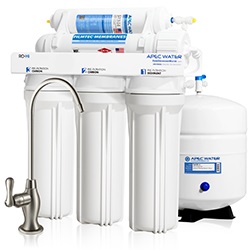
Healthy and Convenient!
Our Featured Reverse Osmosis Drinking Water System



